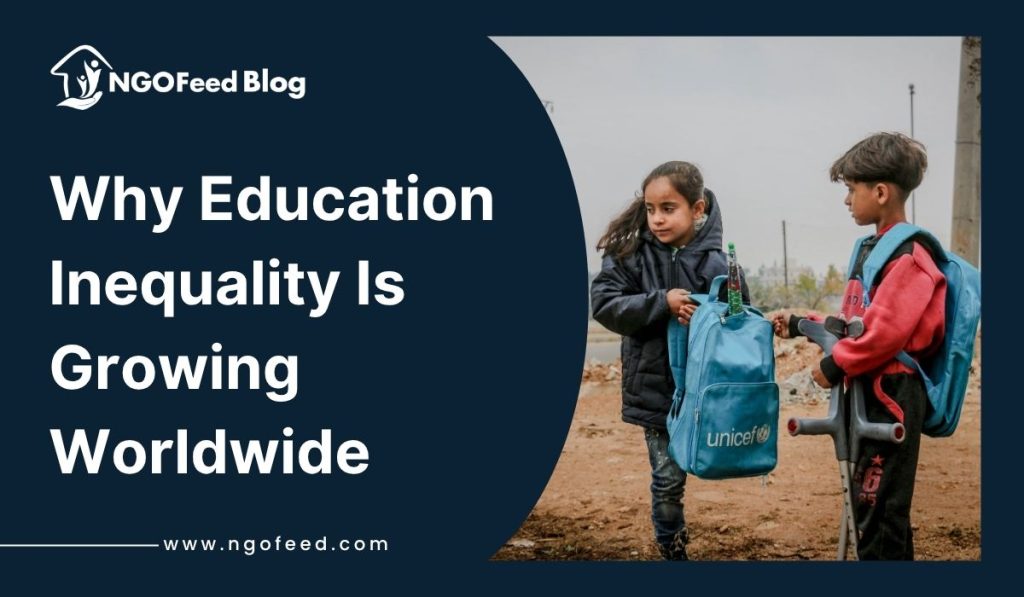
Education Inequality: Education is considered to be the strongest weapon of social mobility and equality. However, even with the advances in the enrolment of schools worldwide in the last few decades, education inequality is not fading away; it is changing, and in most instances, it is getting worse. There are still millions of children who cannot have a quality education, and there are quite different learning opportunities offered to different children based on their place of residence, their level of income, gender and social background.
The widening disparity in education is not only an educational problem, but a measure of structural inequalities in society. Since poverty and conflict lead to digital divides and policy failures, there are several aspects that expand inequities in learning outcomes around the globe. Knowledge on why the inequality of education is rising is important to NGOs, policymakers, and communities in achieving a more inclusive and equitable future.
Table of Contents
What Is Education Inequality?
The inequality of education is the lack of parity in the distribution of educational opportunities, resources and outcomes between various categories of people. These differences may be premised on:
- Income and social-economic status.
- Gender
- Geographic (urban vs rural) location.
- Disability or special needs
- Ethnicity or language or migration status.
It is where other children can get access to high-quality schools, trained educators, and digital tools; others have to wrestle with poor infrastructure, a shortage of educators, or even no access to education whatsoever.
The Current State of Education Inequality Worldwide
Nonetheless, inequality is a serious issue of concern in the world, even though access to education has greatly improved:
- Approximately 272 million children and youth are out of school in the world.
- There are 133 million girls out of school, particularly in the low-income areas.
- The illiterate population in the world is predominantly composed of women (two out of three).
Although the enrolment in primary school has improved across the world, the difference is more pronounced in secondary and higher education and in this case, the dropout figures skyrocket particularly in girls and the poor.
Education inequality is not only about access—it is also about quality. A significant number of school-going children do not learn the essential skills in literacy and numeracy, an indicator of a more inherent learning crisis.
Key Reasons Why Education Inequality Is Growing
The problem of education inequality is on the rise because of structural and emerging issues.
Economic Inequality and Poverty.
One of the largest limitations to education is poverty. Children of poor families are not able to afford school fees, uniforms, transportation, and digital devices.
Parents compel their children to work on most occasions rather than going to school. Children in bad situations have a high chance of dropping out or not even entering school.
War and Political Unrest.
Education inequality is high in the conflict-affected regions. Schools get burnt down, teachers are displaced, and children are displaced.
Such interruptions produce educational disparities in the long-term, which deprive millions of children of a uniform education.
Gender Inequality
Despite the achievements, there are several areas of the world where there are gender inequalities. In other areas, girls tend to drop out because of:
- Early marriage
- Household responsibilities
- Safety concerns
- Cultural norms
Concurrently, boys in some places are in fact losing interest in education, which indicates that inequality is transforming and not going away.
Geographic Disparities
Access to education is significant in terms of location. Rural and remote settings usually do not have:
- Schools and infrastructure
- Qualified teachers
- Transportation facilities
In cities, however, the resources and opportunities are more likely to be better, and the disparity between urban and rural learners increases.
Systemic and Policy Failures.
Even the education systems can be based on inequality. As global reports revealed, less than ten per cent of countries possess powerful legislation that provides inclusive education to every citizen.
Lack of inclusive policies, bad curriculum design, and underfunding of schools are some of the areas that lead to unequal learning outcomes.
The Role of Technology and the Digital Divide
The technology can change education, but it has also increased inequality.
School closures during the COVID-19 pandemic impacted more than 1.6 billion learners and the transition to online learning revealed significant digital access disparities.
Students with access to:
- Internet
- Devices
- Digital literacy
were in a position of pursuing further education, and millions of other people were left out.
This digital gap persists even in the present whereby the developing countries have limited access to technology.
Impact of Education Inequality on Society
The impact of education inequality is long-lasting and not limited to the classroom.
Economic Inequality
Education lowers the chances of employment and earning power, which boosts cycles of poverty. An extra year of education can dramatically raise the level of income.
Social Inequality
Social mobility is influenced by education. In the absence of equal access, the poor groups are left out of the opportunities, increasing social gaps.
Gender Inequality
The denial of education to girls will result in:
- Higher child marriage rates
- Mothers who die in greater numbers.
- Reduced participation in the workforce.
Development Problems Affecting the World.
Inequality in education delays the achievement of global objectives like the reduction of poverty, equality between the sexes and sustainable development.
The Role of NGOs in Reducing Education Inequality
The NGOs are instrumental in solving the issue of education inequality, particularly those that are underserved in communities.
Getting Education.
The NGOs construct schools, offer scholarships, and facilitate the enrolment of children who are not able to afford school.
Online Education Programs.
A lot of organizations implement digital tools and e-learning platforms to close the digital gap.
Community Awareness Programs.
NGOs sensitize the families on the value of education, particularly for girls and marginalized groups.
Policy Advocacy
They support the policies of inclusive education and more funds for education systems.
Appealing to the Vulnerable Groups.
The NGOs target children with disabilities, refugees, and rural people who are usually left behind.
Challenges in Addressing Education Inequality
The attempts to eliminate inequality have several obstacles:
- Incidentally, small funds and resources.
- Many regions are not stable politically.
- The cultural and social barriers.
- Rapid population growth
- Technological disparities
Also, the education systems are still disrupted by global crises like pandemics and climate change.
The Way Forward: Solutions for a More Equal Future
In order to curb inequality in education, there should be a multi-dimensional approach.
The Investment in Inclusive Education.
The governments should focus on promoting fair education policies that provide access to all people, and marginalized groups should have access.
Bridging the Digital Divide
It should increase internet availability, the affordability of internet equipment, and digital literacy.
Empowering Public Education Systems.
Learning outcomes can be improved by improving infrastructure, training of teachers and curriculum.
Advancing Gender Equality in Education.
Specific initiatives should be used to overcome the obstacles that prevent girls and other underprivileged groups from attending school.
Promoting International Collaborations.
Scaling solutions depend on collaboration between governments, international organizations and NGOs.
Conclusion
Education inequality is not merely an issue; it is an ever-increasing crisis at the global level, threatening social and economic developments. Although access to education has been on the rise over the years, there are still deep-rooted disparities which restrict access to education among millions of children in the world.
Reasons behind this inequality are many and go across poverty and war to technological differences and systemic problems. Nonetheless, through good policies, participation of communities, and continued work of the NGOs, it is possible to have a more inclusive education system.
Access to quality education is not only an objective but a necessity to develop a just, sustainable, and successful future for everyone.
Frequently Asked Questions (FAQs)
1. What is education inequality?
Education inequality is described as inequality in access to quality education, depending on such variables as income, sex, and place.
2. What is causing the growth of inequality in education in the world?
It is increasing as a result of poverty, conflict, digital divides, gender disparities, and poor education systems.
3. What is the impact of technology on education inequality?
Although technology has the potential to increase access, the absence of digital resources has further increased the disparity between privileged and disadvantaged learners.
4. What can be done to achieve education inequality?
By providing inclusive policies, increased funding, access to the digital divide, community awareness, and NGO support.
Top NGOs State Wise List
Related NGO's Role Posts