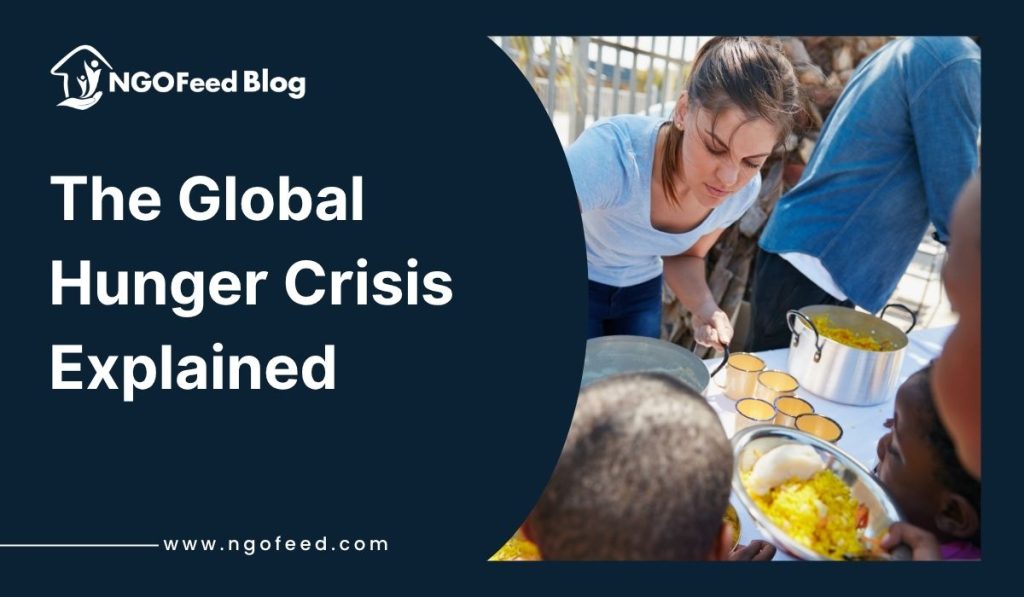
Global Hunger Crisis Explained: Hunger is still one of the most burning humanitarian issues of the time. With the development of technology, agriculture, and the global world, millions of people are still unable to obtain healthful and productive lives with the help of sufficient food. The world food crisis is not only a crisis of food shortage, but it has a close relationship with poverty, inequality, conflict, and climate change.
The extent of hunger is frightening today. Hundreds of millions of people are currently under acute hunger, and billions of people are affected in some form of food insecurity worldwide, as reported by the world. The governments, NGOs and international organizations are trying their best to solve this crisis, but the issue being complicated needs long-term, coordinated remedies. The concept of real causes and effects of hunger is the initial step to an effective transformation.
Table of Contents
What Is the Global Hunger Crisis?
The global hunger crisis is a general inability to access adequate, safe and nutritious food to have a healthy life. It involves undernourishment (chronic hunger) and food insecurity, in which individuals lack secure access to food.
Hunger does not always manifest itself physically; in fact, it may prevail even in a society where people face food but may be unable to afford it or lack access. It also has hidden hunger in which individuals eat adequate calories but inadequate nutrients.
This is not an African or an Asian crisis; it is the crisis of countries not only of Africa but also of Asia, Latin America, and even of developed countries. It is an international problem, and it needs to be taken into collective responsibility.
The Current State of Hunger Worldwide
The food crisis is still intense in the world:
- In 2024, 673 million individuals were hungry.
- Moderate or severe food insecurity affects almost 2.3 billion individuals.
- The world is experiencing a level of acute hunger of around 318-319 million individuals.
- Africa is still the worst hit area where more than 20 percent of the population is starving.
The crisis has also been aggravated by recent events in the world. Civil wars, economic upheavals and climatic disturbances have kept increasing the number of hungry individuals. As a matter of fact, hunger levels are still higher than they were before the pandemic, which demonstrates the vulnerability of the global food systems.
Major Causes of the Global Hunger Crisis
Hunger cannot be attributed to one thing; it is the culmination of several interrelated issues.
Conflict and Instability
Hunger is mostly caused by conflict in the world. Wars interfere with food production, tear down infrastructure, and cause people to move out of their homes. Almost three-quarters of the food-insecure individuals are in conflict-prone regions.
The effects of conflict in countries are usually an outcome of famine-like conditions where farmers are unable to produce, and the supply chains are completely disturbed.
Climate Change
Another cause of hunger is climate change. Droughts, floods, and heatwaves are some extreme weather phenomena that ruin crops and lower agricultural productivity.
Climate shocks also impact the availability of water and soil fertility, making it hard for farmers to sustain their lives. Food insecurity is predicted to become graver as the problem of climate change escalates.
Economic Poverty and Inequality.
Poverty restricts the purchasing power of people to purchase food when food is readily available. The increase in food costs and inflation has made healthy food unaffordable to low-income families.
The interconnection between hunger and economic disparity is also significant, as 2.6 billion individuals all over the world are unable to afford healthy nutrition.
Displacement and Migration
Conflict, calamities, and poverty drive millions of people out of their homes. Populations that are displaced are usually deprived of land, employment and constant sources of food; thus, they are more exposed to hunger.
Weak Food Systems
Food systems in most regions are ineffective or weak. Poor infrastructure, food wastage, absence of storage facilities, and inequality in food distribution are some of the issues that lead to food insecurity.
Impact of Hunger on Health and Development
Hunger is not limited to the shortage of food only; it impacts all the spheres of human development.
Health Problems and Malnutrition.
Malnutrition is a result of hunger, and it makes the body more vulnerable to diseases since it suppresses the immune system. The children are particularly vulnerable, and millions of children are stunted and wasting.
Impact on Children
Children with hunger usually struggle with:
- New physical and cognitive retardation.
- Poor academic performance
- Greater morbidity and death rate.
- Childhood malnutrition may be long-lasting.
Economic and Social Impact
Hunger decreases productivity, diminishes learning chances and escalates medical expenses. It is also a cause of poverty cycles, and hence, communities find it more difficult to progress.
Gender Inequality
The disparity in access to resources, education, and labour opportunities for women and girls negatively impacts them as they experience an unequal number of victims of hunger.
The Role of NGOs in Combating Hunger
NGOs are very vital in solving world hunger crisis by providing short term relief and long term interventions.
Emergency Food Assistance
During crises, like the conflicts, natural calamities, and regions in famine, food is given by the NGOs.
Nutrition Programs
To avert malnutrition, they institute initiatives that centre on child diet, maternal wellness, and food safety.
Agricultural Sustainability Program.
A large number of NGOs encourage sustainable agriculture, train farmers, and assist local food systems.
Community Empowerment
NGOs aim to create resilience in communities together with communities by:
- Promoting livelihoods
- Supporting women farmers
- Improving access to markets
Advocacy and Policy Change
The NGOs also demand a superior policy, more money, and a more powerful global pledge to stamp out hunger.
Their grassroots strategy keeps the interventions localized to the needs and long-term sustainable.
Challenges in Ending Global Hunger
Although the world tries to improve, several difficulties prevent the process:
- Humanitarian financing holes.
- Unstable politics in risky areas.
- Unpredictable climatic conditions in the agricultural sector.
- Food distribution disparity.
- Increased world population and food needs.
Moreover, recent crises in the world have overstretched resources and slackened the momentum towards the realization of Zero Hunger.
Solutions and the Way Forward
To eradicate world hunger, a multi-dimensional and multi-causal approach is needed.
Strengthening Food Systems
Better access to food can be guaranteed by enhancing agricultural productivity, storage, and distribution.
Investment in Sustainable Agriculture.
Farming practices that are climate resilient can assist the communities to adjust to environmental alteration.
Increase in the Social Protection Programs.
Vulnerable populations can be nourished by cash transfers, food subsidies, and nutrition programs.
Global Cooperation has to be promoted.
There should be collaboration of governments, non-governmental organizations, as well as international organizations to combat hunger on an international level.
Empowering Communities
In coming up with solutions to the problems, the local communities should be engaged to make them sustainable.
Conclusion
The world hunger crisis is a compelling and serious problem that impacts millions of lives on a daily basis. Although there has been an improvement, the world is yet to achieve zero hunger. Food insecurity is still driven by conflict, climate change, economic inequality, and poor food systems in regions.
NGOs have a very crucial role to play in this by alleviating the crises, backing sustainable growth, and ensuring the change of systems. Nonetheless, hunger is a problem that can only be solved through the concerted efforts of governments, communities, and individuals.
Knowing the roots and effects of hunger, we can take significant actions to make this world a place where every person will be able to enjoy safe and healthy food.
Frequently Asked Questions (FAQs).
1. What is the international hunger crisis?
It is the inability to access enough healthy food in the entire world.
2. What are the chief causes of hunger in the world?
The major causes are conflict, climate change, poverty, economic inequality, and poor food systems.
3. What is the number of the world population that is hungry?
There are hundreds of millions of hungry people and billions of food insecurity in one way or another.
4. What can be done to alleviate hunger in the world?
By using sustainable agriculture, enhanced food systems, social protection initiatives, and international collaboration.
Top NGOs State Wise List
Related NGO's Role Posts