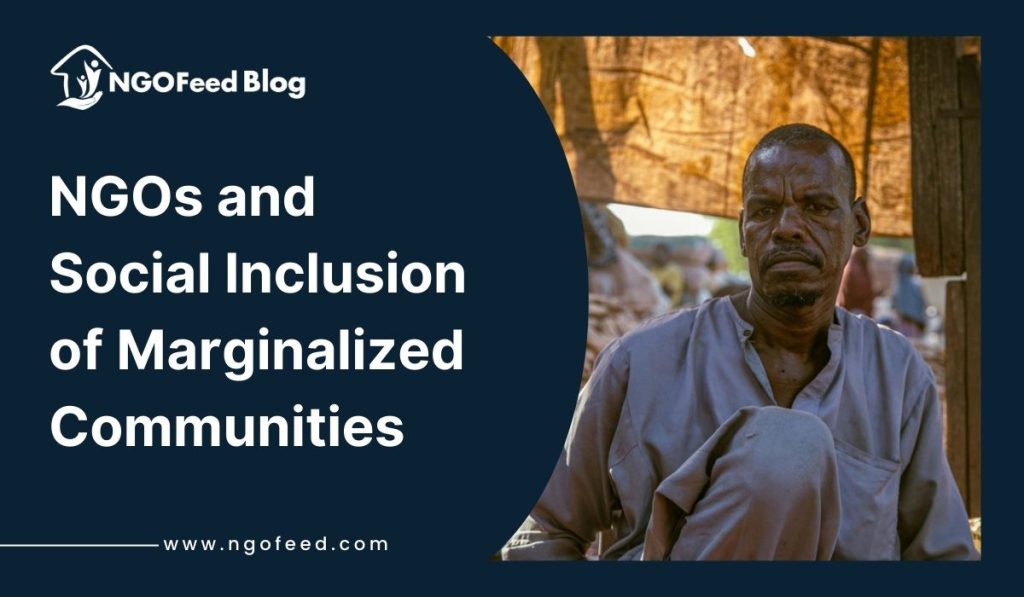
NGOs and social inclusion of marginalized communities: In every society, certain groups face systemic barriers that limit their access to education, healthcare, employment, justice, and decision-making. These underserved communities are not an exception: they have not just a low income, but also face discrimination and lack of social visibility, mostly because of their caste or gender and disability, ethnicity and religion, and poverty or social identity. Social inclusion is meant to change this fact by making sure that all people have equal chances, honour, and that they can fully contribute to society. The Non-Governmental Organizations (NGOs) have a crucial role in enhancing inclusion through communal empowerment, rights promotion, and creating sustainable channels towards equality and involvement.
Table of Contents
Understanding Social inclusion of marginalized communities
Social inclusion entails enhancing the conditions of participation in society, especially by people who have been disadvantaged by some social, economic, and political exclusion. It promotes equal access to opportunities, resources, and rights and eliminates the impediments to living with dignity.
Inclusion cannot be charity; it is justice. It involves institutional, policy, and attitude adjustments whereby all people, irrespective of their background, are allowed to contribute to the life of the community.
Who Are Marginalized Communities?
The groups that are marginalized consist of those who are discriminated or excluded because of:
- Caste and ethnicity
- Gender and sexual identity
- Disability
- Economic vulnerable and poverty.
- Religious minority status
- Migration status
- Tribal or aboriginal identity.
Cases such as Dalits communities, Adivasi communities in India, migrant workers, persons with disabilities, and women in villages tend to overlap and disadvantage them. Marginalization is typically a multidimensional phenomenon, that is, it encompasses education, employment, health, political representation, and social acceptance.
Why Social Inclusion Matters
Social inclusion has various benefits to societies:
- Cuts Poverty: Economic stability through equal access to resources.
- Fosters Social Solidarity: Inclusion stems out conflict and discrimination.
- Enhances Governance: Policies become more responsive and effective when the voices of the marginalized are listened to.
- Empowers Democracy: Proper democracy involves the involvement of every group in the society.
- Inclusive societies are stronger, creative and sustainable.
The Role of NGOs in Promoting Inclusion
NGOs translate as intermediaries between institutions and the marginalized populace. They can deal with exclusion because they have a grassroots presence, are flexible, and are community-based.
a. Awareness and Advocacy
ActionAid is one of the organizations that strive to eradicate poverty and injustice through promotion of policy changes and voice of those who are marginalized. Through advocacy, structural inequalities are addressed in the local, national and global levels.
NGOs raise awareness, hold policy discussions, and engage in community mobilisation to combat discrimination and promote inclusive laws.
b. Education and Dexterity Building.
Empowerment is based on education. NGOs create community schools, bridge education programs, digital literacy centers and vocational training centers which are specific to vulnerable populations.
In India, Pratham has made a critical contribution to enhancing the learning outcomes of underserved children and this case shows how focused educational efforts can decrease inequality.
c. Economic Empowerment
Inclusion is enhanced by economic independence. NGOs support:
- Self-help groups for women
- Skill development programs
- Micro-enterprise initiatives
- Financial literacy and credit.
Economic inclusion has demonstrated the transformative force of SEWA empowering thousands of self-employed women workers through better income security and labor rights.
d. Legal Assistance and Rights Guardianship.
The underprivileged in society do not have access to justice. NGOs give legal advice, documentation services, and representation to defend the rights concerning land, labor, gender-based violence, and discrimination.
An example is Jan Sahas, who undertakes much to provide access to justice and dignity to caste-based violence survivors as well as migrant employees.
e. Social Inclusion and Culture.
In addition to the support in economics and law, NGOs break stereotypical and social taboos. They foster respect and diversity through storytelling, leadership development, cultural programs and by engaging the masses.
The Leprosy Mission strives to come up with stigma elimination relating to leprosy through rehabilitation, skills training, and awareness programs.
Participatory Development and Community Leadership
Sustainable inclusion occurs when communities are not only benefactors but also participants. NGOs encourage participative strategies because:
- Constituting community committees.
- The promotion of local leadership.
- Funding the youth and women leadership programs.
- Making community-based surveillance over state apparatus easier.
The difference is that when marginalized people are the initiators themselves, the effect will be more profound.
Challenges Faced by NGOs
Various challenges are associated with NGOs regardless of their critical role:
Low Financing: The amount of funds available is limiting to expansion.
Policy Limits: Advocacy can be limited by policy.
Social Resistance: Prejudices that are deeply set can slack change.
Lapses in Co-ordination: Sometimes there is a lack of co-ordination between NGOs and government.
These issues need collaborations, creativity, and long-term dedication.
Real-World Examples of NGO Initiatives
NGOs are changing lives around the world, especially in India whereby:
- Empowering girls in the less privileged groups to attend secondary school.
- Arranging migrant workers to be able to access welfare programs.
- Inclusion education models with persons with disabilities.
- Getting people living in rural and tribal areas to get livelihood opportunities.
- Community based healthcare in low-income settlements.
These programs show that inclusion is possible with the regular, community-based efforts.
Measuring Impact: What Successful Inclusion Looks Like
- Social inclusion can be considered successful when:
- Disfavored groups engage in local governance.
- The level of income and the employment opportunities are better.
- The attendance of school among the vulnerable children rises.
- Social stigma decreases
- There is more confidence and agency, according to communities.
The measurement of impact can involve both qualitative responses of the community and quantitative measures of impact in terms of employment rates, levels of literacy and access to services.
How Individuals and Partners Can Contribute
Collective action is needed in inclusive change. People and organizations can:
- Volunteer skills or time
- Collaborate with NGOs in CSR.
- Support advocacy campaigns
- Donate resources
- Enhance voices of the marginalised in the online space.
Teamwork increases effectiveness and hastens social change.
FAQs
1. Social inclusion in the context of NGOs?
The term social inclusion is used to refer to the initiatives that help to provide marginalized people and groups with equal opportunities, rights, and access to society. The NGOs enhance social inclusion through promoting access to education and livelihoods, as well as fair policies by combating discrimination.
2. What are the marginalized communities?
The groups that experience systemic exclusion but are marginalized consist of caste, ethnicity, gender, disability, poverty, religion, status of migration and social identity. In most instances, this covers Dalits, tribal communities, migrant laborers, individuals with disabilities, rural women and other disadvantaged communities.
3. What are the ways of social inclusion that NGOs foster?
The NGOs encourage inclusion by conducting awareness, education, skill building, livelihood support, legal advice, policy advocacy, and community leadership programs. They can learn about the local problems and provide specific solutions due to their grassroots approach.
4. What is the significance of social inclusion to sustainable development?
Social inclusion minimizes poverty, enhances democracy, fosters social peace and guarantees fair economic development. Devoid of inclusion, development would be imbalanced and lots of communities would still be at a disadvantage structurally.
5. What can people do to assist NGOs that deal with social inclusion?
One can act by volunteering, giving donations, collaborating via CSR programs, raising awareness, promoting inclusive policies, and giving a voice to the marginalized in their communities and online platforms.
Conclusion
Social inclusion is an important goal for all communities, but it is also a fundamental moral and democratic value. Non-governmental organisations (NGOs) play a key role in the process of creating social change by providing assistance to those who are disadvantaged, by providing opportunities for them to participate in decision-making processes, and by advocating for policy changes that impact them. Through education, economic empowerment, legal aid, and advocacy, NGOs are working towards building societies that provide all people with the opportunity to live with dignity, to be included, and to be represented in public life.
It takes time and effort to build an inclusive society, and the work that NGOs are doing is part of that long-term, ongoing commitment to building a future in which no one is left behind.
Top NGOs State Wise List
Related NGO's Role Posts