
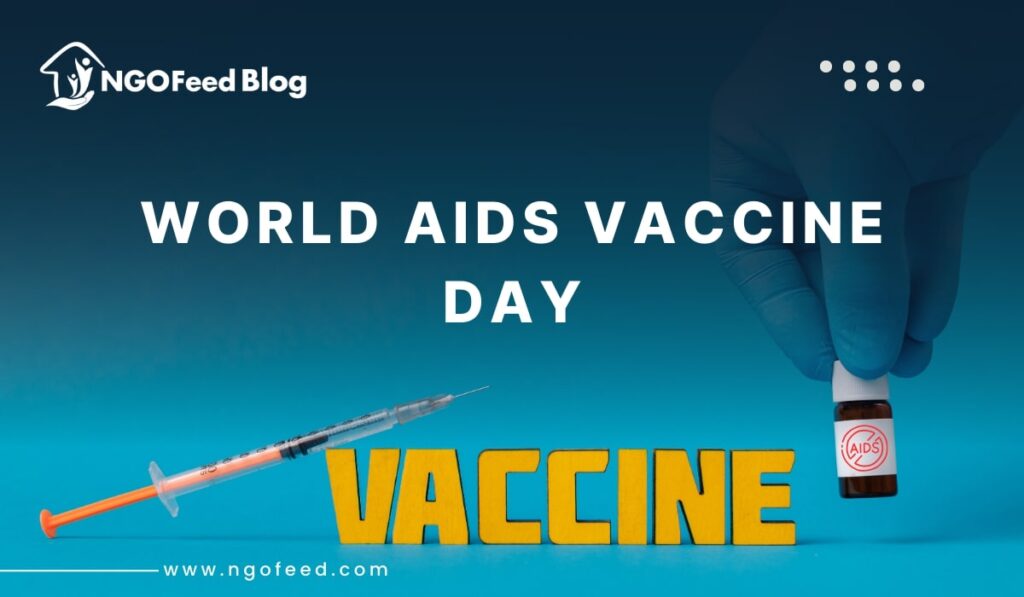
Observed annually on 18 May, World AIDS Vaccine Day is a worldwide notable event highlighting the desperate need for a preventative vaccination against the Human Immunodeficiency Virus (HIV). Also known as HIV Vaccine Awareness Day, this day is meant to raise awareness worldwide of the need of an HIV vaccination in slowing down the AIDS pandemic. It honors the ongoing efforts of scientists, medical practitioners, community volunteers, and volunteers working toward creating a secure and efficient vaccine.

As the world battles the lasting public health, social, and economic effects of HIV/AIDS, the remembrance takes on even more meaning in 2026. Even if antiretroviral therapy (ART) has turned HIV from a fatal disease into a controllable chronic condition, a vaccine remains the most effective long-term solution to eradicate new infections and promote worldwide health equity.

Table of Contents
World AIDS Vaccine Day: Origin and Historical Background
World AIDS Vaccine Day’s start can be found on May 18, 1997, when then U.S. President Bill Clinton pronounced a profound declaration in a commencement speech at Morgan State University:

“Only a truly effective, preventive HIV vaccine can limit and eventually eliminate the threat of AIDS.”
This visionary statement drove the worldwide scientific and public health community to redouble their efforts in HIV vaccine research. First observed in 1998, World AIDS Vaccine Day has grown to become a worldwide forum for advocacy, cooperation, and knowledge.
Also Read: Role Of NGOs in Psychological Support
Relevance and Context in 2026
The weight of HIV still weighs the planet as of 2026:
39.8 million people worldwide are living with HIV.
- About 2.4 million Indians are HIV-positive, with new cases disproportionately striking vulnerable groups including women, teenagers, transgender people, sex workers, and injecting drug users.
- Social stigma, misunderstanding, and unequal healthcare access are still major obstacles to prevention and treatment, even if awareness and treatment improve.
- Furthermore, revealing the vulnerability of world health systems following the COVID-19 pandemic’s effects is the need for vaccine preparation, local involvement, and persistent funding for long-term epidemic control.
World AIDS Vaccine Day Theme for 2026
As of now, no official global theme has been announced for World AIDS Vaccine Day 2026. For many years, this observance (also called HIV Vaccine Awareness Day) has focused more on awareness campaigns rather than a single fixed global theme.
Also Read: Role Of NGOs in Cancer Care
Reasons for World AIDS Vaccine Day observation
World AIDS Vaccine Day is more than just a calendar date; it is a symbolic and strategic reminder of the group effort to eradicate AIDS as a public health danger.
Main goals: Emphasize the absolutely vital part that vaccine research plays in helping to stop HIV infections.
- To increase public understanding of the complexity and importance of HIV vaccine research.
- To promote involvement in clinical studies, particularly from those groups impacted.
- To show respect for researchers and volunteers engaged in HIV prevention campaigns.
- For long-term scientific projects, to generate political backing and money.
- Honoring this day also highlights the human toll of the AIDS epidemic and reinforces the ethical obligation of worldwide stakeholders to create a solution that benefits all, irrespective of country or income.
Scientific Development and Continuing Difficulties
1. Scientific Complication
Due to: HIV presents particular difficulties.
- Its high mutation rate and genetic variety.
- Its capacity to avoid the immune system by fitting into host DNA.
- The absence of organically gained immunity in afflicted people.
Also Read: Role Of NGOs in Disabled Person
2. Latest advancements
- Building on the success of COVID-19 vaccines, early trials are assessing new mRNA HIV vaccines designed to elicit extensively neutralizing antibodies.
- Research is being done to use broad-spectrum neutralizing antibodies (bNAbs) to prevent and control HIV infection.
- Designed to train the immune system to control HIV without medications and hence lessen reliance on life-long ART, therapeutic vaccines
3. Projects for India
- Through: India has become a major participant in international HIV vaccine research
- Participation in international vaccine studies by the National AIDS Research Institute (NARI) and Indian Council of Medical Research (ICMR).
- Public-private partnerships targeting native vaccine development and community-based testing techniques.
How You Could Assist
At the Individual Level:
- Keep current and teach others about HIV/AIDS, as well as continuing vaccine development.
- Get Involved in online or public awareness campaigns.
- Show empathy and non-discrimination for those who are HIV-positive.
In Schools and Universities:
- Plan posters, debates, and awareness marches.
- Invite health professionals to interactive sessions to cover vaccine science.
- Establish young clubs to participate in peer education projects.
In medicine and social effort:
- Champion regular HIV testing and early diagnosis.
- Encourage high-risk groups to use PrEP (pre-exposure prophylaxis).
- Inspire neighborhood-based involvement in vaccine research.
Function of NGOs at the National Level
Particularly in underprivileged areas, non-governmental organizations (NGOs) are instrumental in reaching and affecting national AIDS programs.
Also Read: Role of WHO in Healthcare
Key Roles Played by NGOs
- Door-to-door campaigns, workshops, and awareness campaigns in rural districts and metropolitan slums are awareness generation activities.
- Prevention Services: Educating high-risk groups, distributing clean syringes, and providing condoms.
- Counseling, ART adherence assistance, nutrition assistance, and housing for HIV-positive people constitute care and support.
- Assuring human rights protection and access to health services without discrimination via advocacy and legal aid.
- Participating in Research: Supporting and helping recruiting trial participants while upholding ethical guidelines.
Active NGOs in India:
- New Delhi’s India HIV/AIDS Alliance emphasizes health rights and preventive plans for important groups.
- Offering health care and education to underprivileged communities, particularly the LGBTQ+ population, Naz Foundation New Delhi
- SAATHII (Chennai) seeks to improve underprivileged areas’ access to excellent medical care.
- Mumbai’s Humsafar Trust focuses on HIV education and advocacy for sexual minorities.
- Under the National AIDS Control Programme (NACP-V), NGOs work with the National AIDS Control Organization (NACO) to advance strategic objectives including eradicating AIDS as a public health concern by 2030.
Conclusion
Though it is a long and intricate road, the path to an efficient HIV vaccine is also one of hope, resilience, and great human effort.
On this day, let us not only recognize the contributions of scientists and volunteers but also renew our shared responsibility to dispel stigma, combat false information, and guarantee that no one is left behind. A world free of AIDS is not only conceivable but also feasible thanks to scientific innovation, equitable access, and community inspiration.
Top NGOs State Wise List
Related Important Days Posts
International Day of Charity 2026: History, How to Celebrate, Theme, etc.
International Day of Charity 2026: The International Day of Charity, observed annually on September 5th, is a global reminder of the transformative…
World Soil Day 2026: Theme, History, Importance, Role of NGOs, etc.
World Soil Day, observed on 5 December, is a global initiative dedicated to raising awareness about the critical role soil plays in…

World Oceans Day 2026: History, Theme, NGOs Work, Importance etc.
Observed annually on June 8, World Oceans Day offers a worldwide forum to acknowledge the vital part oceans play in supporting life on Earth. Covering more than 70% of the Earth's surface, oceans also act as the planet's life-support system by regulating temperature, producing oxygen, storing carbon dioxide, providing food, and supporting economies. …

World Cleanup Day 2026: Theme, History, NGOs Work, Importance, Government Role etc.
Every year on 20 September, World Cleanup Day is celebrated to inspire people all around the world to come together and remove…
International Day for the Remembrance of the Slave Trade and Its Abolition 2026: Theme, History, Importance, NGOs Work, etc.
Celebrated yearly on 23 August, the International Day for the Remembrance of the Slave Trade and Its Abolition is a serious opportunity…
National Handloom Day 2026: Theme, History, NGOs Work, Importance, Government Role etc.
Observed as National Handloom Day in India every year on 7 August, it honors the ageless beauty, legacy, and financial importance of…
World Brain Tumour Day 2026: Theme, NGOs Work, Importance, History, etc.
World Brain Tumour Day is observed on 8 June every year and is officially recognized as a day to create awareness of…

National Safe Motherhood Day 2026: Objective, Work, History, Challenges, Govt Initiative etc.
National Safe Motherhood Day, celebrated every year on April 11th in India, is a vital initiative focused on enhancing awareness about the…