
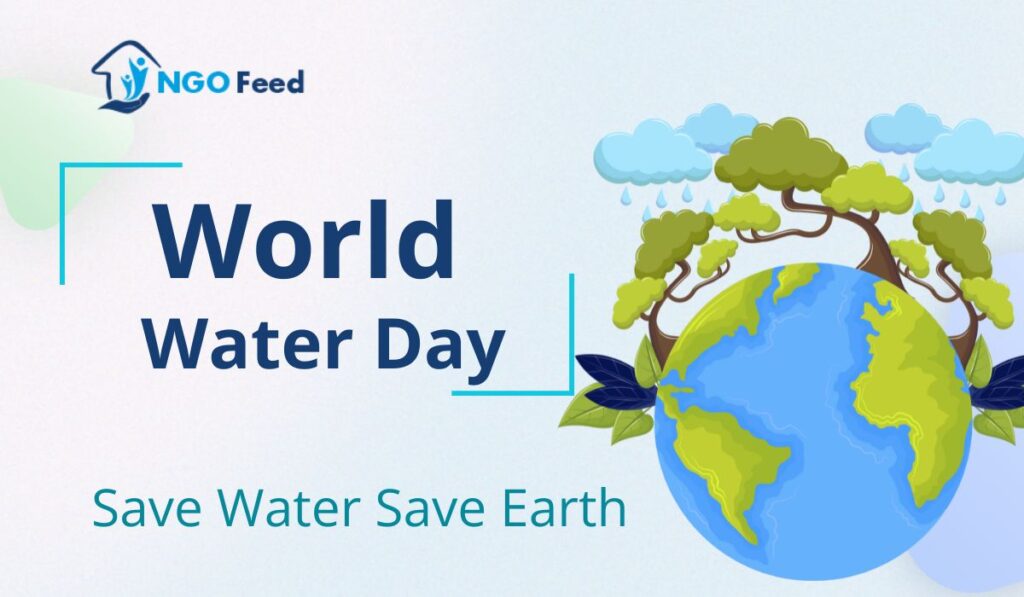
World Water Day 2026: Water is a cause of peace but also a stimulus for conflict. A situation where there is insufficient or polluted water and a community or country does not provide equal or no access to this resource will lead to conflict. Over 3 billion people from all across the globe depend on waters that flow over international borders. While only 24 countries in the world have cooperation agreements to share all their water, the ones that do cooperate are lifesavers.

Water is the brick of health. In all corners of the earth, there are individuals who cannot afford the luxury of clean and secure drinking water. 22 March is considered International Water Day, a day that aims to call attention to the water-related problems that almost every nation is struggling with.

About World Water Day 2026
World Water Day was initiated by the United Nations on 22 March 1993 as an annual observance that caters for the significance of fresh water. The purpose of the annual celebration is to the water and reminding of the fact that every day, billions of people in the world do not have a possibility to get safe water, which leads to the global water crisis.

A core focus of World Water Day is to support the achievement of Sustainable Development Goal 6: access for all to drinkable water and sanitation by 2030. The United Nations Organization has established World Water Day to address concerns and bring a voice to the people who are most in need across different countries.
World Water Day 2026 Theme
The theme of World Water Day in 2026 is “Water and Gender”
The theme for World Water Day 2026 is “Water and Gender” — highlighting the critical link between water, sanitation, and gender equality, and how equitable access to water empowers women and girls.
Importance of World Water Day
We’ve all heard the slogan “Preserve water, preserve life,” and in India, we’ve also heard “जल है तो कल है,” which emphasizes the importance of saving water not just for ourselves but for future generations. The observance of World Water Day inspires people to save water and highlights the significance of doing so. In this section, you’ll learn more about the importance of World Water Day in detail.
1. It affects millions of people around the world.
Unbelievably, 780 million individuals don’t have clean and easy-to-access drinking water. Intake of water containing all pollutants could be dangerous and life-threatening. The worst part of this is that it may even seem like a problem that third-world countries face, but the town of Flint, Michigan, proved this wrong by showing that water problems in the US are also a thing.
2. Water pollution affects wildlife.
Water is also not just needed for consumption by people. The number of animal deaths that occur every year as a consequence of water pollution is endless. Pollution can be a multi-faceted problem, ranging from mere physical litter to toxic wastewater and chemical runoff that make the animals living in, or drinking from, the water comprehensively unwelcoming.
3. Water has a vast connection to other environmental issues.
Every year, World Water Day has a theme that covers global water problems; for example, in 2020, it was “Nature for Water”, contesting that Nature is the key solution to the water problems. Above all, a large number of the environmental problems we currently have are interconnected- climate change and ecosystem degradation, thus not only being its prevailing factors but also its consequences, causing water pollution, floods, and droughts.
Top 5 NGOs Working For Water Conservation & Clean Water in India
Many NGOs are operating in India at no cost, and we have come across the top 10 NGOs in India, which are the ones that have improved the situation and are giving assistance to the people. There are numerous issues in India, but these NGOs are doing a fantastic job. Please review our list of the top 5 NGOs for Water Conservation & Clean Water in India.
1. WaterAid India
WaterAid India works to improve access to clean water, decent toilets, and good hygiene practices. In 2023, they focused on strengthening water security, promoting sustainable water resource management, and empowering communities to drive change through advocacy and capacity building.
2. Tarun Bharat Sangh
Tarun Bharat Sangh’s mission revolves around self-reliant communities that live harmoniously with nature. The organization involves the community in every stage of development work, primarily focused on water conservation in Rajasthan, one of the country’s most water-deficient states.
3. Environmentalist Foundation of India
Environmentalist Foundation of India is an NGO that focuses on reviving freshwater habitats like lakes and ponds across the country, with a holistic approach that includes wildlife conservation and habitat restoration.The Environmentalist Foundation of India (EFI) has conducted various studies and found that the only way to revive contaminated freshwater bodies in India is through scientific means. Since its establishment in 2007, EFI has successfully revived several freshwater lakes and ponds in both urban and rural areas.
4. Jal Bhagirathi Foundation
Jal Bhagirathi Foundation is a water conservation NGO in India that operates in the Marwar region of Rajasthan, one of the most densely populated arid zones in the world. For decades, the foundation has been working to overcome the challenge of water scarcity in the region by constructing and reviving rainwater harvesting structures. These structures help recharge groundwater, and the foundation also assists local communities in building rainwater harvesting tanks called “tankas.” Experts believe that the construction of tankas is not only beneficial for the region but also a highly replicable solution for water conservation.
5. Centre for Aquatic Livelihood Jaljeevika
Jaljeevika has been instrumental in promoting water conservation and supporting fish farmers in states like Andhra Pradesh, Madhya Pradesh, Maharashtra, and Jharkhand. The initiative educates farmers on sustainable fishing techniques while also emphasizing the importance of preserving water resources. Fishery cooperatives are encouraged to adopt new technologies and better management practices to improve their livelihoods.
Conclusion
When we work together on water, we create a series of positive ripple effects – establishing peace, economic prosperity and resilience to our shared challenges. We need to take immediate steps on the premise that water is not only a commodity to be used and competed for but a precious natural and human right on which the entirety of our existence depends. On this day of World Water, we all should join together under the creed of water and use water for the sake of peace, creating the foundation of a more stable and prosperous future.
Frequently Asked Questions (FAQs)
Why is World Water Day 2026 celebrated?
World Water Day celebrates the water and challenges us to find solutions for the global water problems. A core focus of World Water Day is to support the achievement of Sustainable Development Goal (SDG) 6: everyone should have clean water and sanitation by the year 2030.
Who introduced World Water Day?
In 1993, the UN General Assembly made this day an annual event to promote the people’s awareness regarding the need for water and its conservation. In fact, it was later incorporated in the UN Conference on Environment and Development in 1992 as schedule 21 during the Rio de Janeiro, Brazil.
Who was the first water man in India?
Rajendra Singh is a conservationist, though. He is also well-known as the Waterman of India. He introduced the conventional process of storing water in some parts of the villages of Rajasthan, which had been depleted for many years by bringing water to them.
Why is World Water Day celebrated?
World Water Day, celebrated on 22 March since 1993, is a yearly United Nations Observance, which is devoted to the issues of the freshwater. World Water Day is the day that gives water a chance and draws attention to the problems of 2.2 billion people having access to safe water. It is not only about making water scarce but also about taking action to deal with the water crisis.
Top NGOs State Wise List
Related Important Days Posts
International Day of Charity 2026: History, How to Celebrate, Theme, etc.
International Day of Charity 2026: The International Day of Charity, observed annually on September 5th, is a global reminder of the transformative…
World Soil Day 2026: Theme, History, Importance, Role of NGOs, etc.
World Soil Day, observed on 5 December, is a global initiative dedicated to raising awareness about the critical role soil plays in…
World Oceans Day 2026: History, Theme, NGOs Work, Importance etc.
Observed annually on June 8, World Oceans Day offers a worldwide forum to acknowledge the vital part oceans play in supporting life on Earth. Covering more than 70% of the Earth's surface, oceans also act as the planet's life-support system by regulating temperature, producing oxygen, storing carbon dioxide, providing food, and supporting economies. …
World Cleanup Day 2026: Theme, History, NGOs Work, Importance, Government Role etc.
Every year on 20 September, World Cleanup Day is celebrated to inspire people all around the world to come together and remove…
International Day for the Remembrance of the Slave Trade and Its Abolition 2026: Theme, History, Importance, NGOs Work, etc.
Celebrated yearly on 23 August, the International Day for the Remembrance of the Slave Trade and Its Abolition is a serious opportunity…
National Handloom Day 2026: Theme, History, NGOs Work, Importance, Government Role etc.
Observed as National Handloom Day in India every year on 7 August, it honors the ageless beauty, legacy, and financial importance of…

World Brain Tumour Day 2026: Theme, NGOs Work, Importance, History, etc.
World Brain Tumour Day is observed on 8 June every year and is officially recognized as a day to create awareness of…

National Safe Motherhood Day 2026: Objective, Work, History, Challenges, Govt Initiative etc.
National Safe Motherhood Day, celebrated every year on April 11th in India, is a vital initiative focused on enhancing awareness about the…