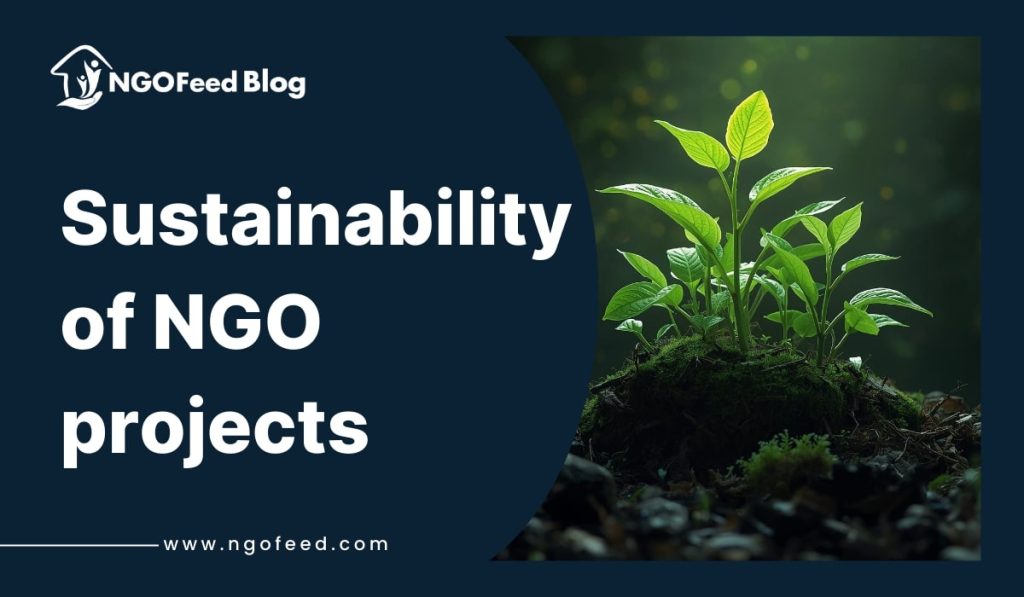
Sustainability of NGO projects: Sustainability is one of the most important standards for assessing the effectiveness of NGO projects. Although a single campaign and a short-term intervention can provide a quick fix or result in increasing awareness of a problem, these interventions do not achieve long-term change without extensive long-term planning and community ownership. What happens after the project ends is a question which is of growing concern among the donors, stakeholders, and even the beneficiaries of the project in the current development scene.
To NGOs, sustainability implies that initiatives need to be structured in a manner that provides sustained effects well after the funds have been exhausted, as well as after the NGO campaigns. This entails changing the emphasis on the individual activities to the systemic level of change, which includes empowering communities, building local capacities, and customizing solutions to real on-ground needs. Sustainable projects do not only deal with continuity of services, but they involve resilience, accountability and capacity to change over the years.
The long-term effect is realized when the sustainability thinking is incorporated by the NGO in all the phases of a project, such as need assessment and implementation, monitoring, and exit strategies. Stakeholder involvement, diversified financing, powerful collaborations, and quantifiable results are crucial components to the success of an initiative to either grow or fail. Besides, adding projects to local governance frameworks and promoting leader development by local communities makes the advancement independent of outside assistance.
This article discusses how NGOs can go beyond single campaigns to establish sustainable, scalable, and impactful projects. With the implementation of strategic planning, the desire to work together, and an emphasis on the long-term value of the organisation over short-term outputs, NGOs can ensure that their activities produce a valuable change that will last not only for generations but also for years.
Table of Contents
Understanding Sustainability in NGO Projects
The idea of sustainability in NGO projects is not about short-term campaigns or interventions that are one-off; it is about making change enduring, even when organizations or external funding are no longer part of the picture. The essence of sustainability is to create and establish programs that are community-based, economically stable, and sensitive to changing demands to make sure that they will produce an effect in the long run as opposed to the short term.
To establish such a foundation, NGOs have to take into account both the strategic planning and systemic integration in the inception stage:
- Community Ownership: Involve beneficiaries, local leaders and stakeholders, not only as beneficiaries, but as planners, execution and decision-makers. Authentic engagement enhances relatability and sustainability.
- Clear Sustainability Goals: Identify SMART objectives that are associated with the needs of the community and are measurable. This gives guidelines, responsibility and a guideline to check the way forward as time goes by.
- Diversified Funding and Partnerships: Independence on one donor or grant is detrimental to sustainability. NGOs are able to achieve resilience through integrating grants, CSR collaborations, earned income models, and multi-sector alliances.
These values help the NGOs make their projects sustainable by embedding them in the project design and the operational frameworks. Sustainability planning creates resilience, community empowerment and ongoing improvement, instead of short-term victories, making projects engines of positive change that run over time.
Community Ownership and Stakeholder Engagement
NGO projects are built based on community ownership and stakeholder engagement, as lasting components of the objects. Communities that have been actively involved in the development, implementation and process of monitoring initiatives are likely to have a high staying power of projects, which are relevant, trustworthy and self-sustaining. Instead of perceiving beneficiaries as passive receivers, sustainable NGOs regard them as change co-creators who have a better understanding of the local issues than any other person.
Successful interaction starts at the planning phase. Engaging local institutions, government, community members, and other partners in the private sector assists NGOs in developing the interventions that can be facilitated to meet real needs and available systems. This is also an inclusive practice that enhances project results and generates accountability and responsibility.
The major practices that can enhance community ownership are:
- Participatory Decision-Making: Visiting communities to help in needs assessment, goal-setting and solution design creates a sense of responsibility and commitment in the long term.
- Capacity Building: Local help in terms of training of local volunteers, leaders and organizations to make sure that skills, knowledge and leadership are not lost as soon as the project is over.
- Good Local Relationships: The cooperation with the grass-root organizations, panchayats, schools and self-help organizations can assist in embedding the projects into the established social and governance systems.
- Open and Clear Communication: Repeated updates, feedback systems, and open communication serve as sources of trust and promote the relentless involvement of all parties involved.
By becoming owned by communities, projects become no longer externally led, but locally maintained. The involvement of stakeholders will also decrease the reliance of NGOs so that communities can adjust, expand, and administer solutions. Finally, robust community ownership turns the short-term interventions into the long-term development outcome based on local leadership and local action.
Financial and Institutional Sustainability
The financial and institutional sustainability factors identify whether an NGO project can outlive the initial funding stage and is able to produce an impact in the long term. Although great ideas and involvement with the community are imperative, the key to long-term success has to do with a solid financial system and the strength of organizational frameworks that help in maintaining steady delivery and expansion.
To realize this, it is important that NGOs change their short-term fundraising behaviour and develop diversified, future-ready institutions. A sustainable financial model helps minimize the risks of dependency and enables organizations to react to the evolving social and economic conditions with confidence.
What enhances financial sustainability?
→ Diversification of fund sources: Grant financing, CSR arrangements, personal donations, membership schemes and earned income initiatives will assist in equalizing money flow and reducing risk.
→ Strategic budgeting: Will fund not only the program delivery but also administration, personnel growth and technology, which will guarantee continuity in operations.
→ Long-term relationships with donors: Transparency in reporting and impact reporting bring in repeat funding and multi-year commitment.
The next equally vital one is institutional sustainability, which is the internal capacity of an NGO which can allow it to act properly despite any external shifts.
What is institutional resiliency?
→ Well-developed governance structures: Effective roles, ethics, and responsible leadership promote credibility and decision-making.
→ Knowledgeable human resources: Due to the training of staff and their leaders, knowledge will be retained, and the stability of the organization will be ensured.
→ Strong systems and processes: Policies, monitors, and evidence-based planning facilitate consistency and scalability.
Combined, the financial and institutional sustainability will make NGOs less project-dependent organizations but more resilient ones. By enhancing their money flows and internal capacity, NGOs will be able to defend their mission, adapt to future difficulties, and continue having a significant impact in the years to come.
Measuring Impact and Scaling Successful Models
Impact measurement is critical in the process of knowing whether NGO projects are having an effective and sustainable change. In the absence of effectively demonstrated results, even the well-meaning projects run the risk of being activity-driven, but impact-driven. The effective measurement of impact also assists NGOs to track progress, make improved decisions, and show value to communities, partners, and donors.
An effective impact measurement strategy would commence with well-articulated goals and measures which capture the short-term deliverables and long-term outcomes. Quantitative measures (e.g. number of beneficiaries served or service delivered) must be supplemented by qualitative data (e.g. feedback within the community, behavioural change). Collectively, these bring out a fuller image of success.
Major aspects of successful impact measurement are:
- Establishing baseline data before the implementation of the project.
- Applying relevant KPIs in line with beneficiary needs and project goals.
- Gathering information regularly using surveys, field reports, and online instruments.
- Refining strategies and enhancing the effectiveness of programs with the help of findings.
After measuring and validating impact, NGOs can work on scaling what works. Scaling is not necessarily about expansion into new geographical locations but can also entail intensifying an effect, adapting an effective model to a new environment, or effecting system and policy change. The strategies to implement successful scaling are flexibility, good partnerships, and sufficient resources.
With a connection of strong impact measurement and a conscious scaling approach, NGOs may be able to make sure that the success of interventions is not just an isolated case but a template of success to be implemented on a large-scale social transformation.
FAQs
1. What is meant by sustainability in NGO projects?
The term “sustainability” in an NGO project refers to the ability of the project to continue providing benefits long after the initial funding has ended or the campaign is finished.
2. Why should NGOs move beyond one-time campaigns?
One-off campaigns only create short-lived changes, while programs intended for sustainable development will create ways of developing these changes over the long term through systems, skills, and community ownership.
3. How does community ownership contribute to long-term impact?
Community ownership of projects creates a broader, more sustainable impact by allowing communities to be involved in the decision-making processes and to take ownership of their projects.
4. Why is diversified funding important for NGO sustainability?
By using multiple sources of funding, NGOs can minimize their risk of losing significant funding and therefore can better support themselves and their programs over time.
5. How does impact measurement strengthen sustainable development efforts?
By measuring the impact of their programs, NGOs can not only evaluate the success of their programs but also develop new ways to replicate their successful models and improve the effectiveness of their programs in other areas.
Related NGO's Article Posts