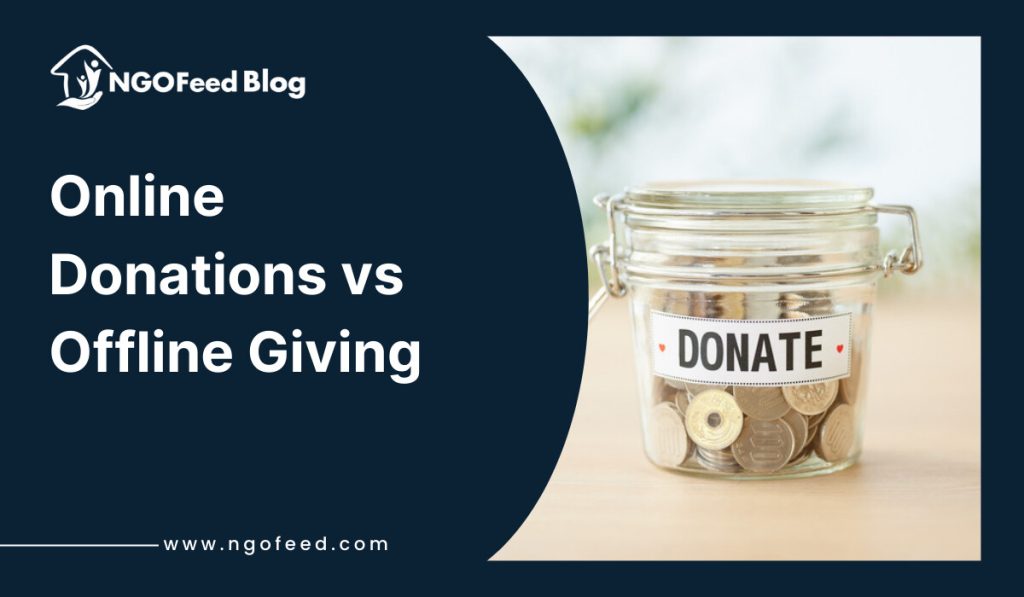
Online Donations vs Offline Giving for NGOs: Nonprofits and NGOs today face a critical strategic question: Should we focus more on Online donations, or continue investing in traditional, offline giving channels? The answer is not binary. It lies in the data. In this article, we explore trends, donor preferences, performance statistics, and practical implications of both channels to help NGOs build sound fundraising strategies.
Table of Contents
The Fundraising Landscape is Evolving
Consequently, the modern fundraising landscape requires a sophisticated “hybrid” strategy that balances innovation with tradition. Charities must bridge the gap between high-tech platforms and high-touch personal interactions to ensure no and physical engagement, organizations can build more resilient, diversified revenue steams that resonate across generations and geographies.
Offline Giving Still a Major Revenue Source
How Much Giving Happens offline?
Consequently, traditional methods like direct mail, face-to-face solicitations, and legacy gifts remain vital cornerstones of financial stability for organizations worldwide.
Key insights:
- Surveys show that a majority of nonprofits are still made offline, including cash, cheques, bank transfers, and fundraising events. In one study of charities, offline donations comprised about 70% of total giving, even though online audiences were similar in size to offline audiences.
- Research in India revealed that many NGOs still raise around 80% of their revenue offline- with online giving representing under 10% of total funds.
Why Offline Giving Persists – Online Donations vs Offline Giving
Offline giving continues to be strong for several reasons:
- Older donor demographics: Many older donors prefer cash, cheques, or in-person giving over digital transactions. The Financial Express
- Trust and personal connection: In-person events and direct mail often build stronger emotional bonds with donors.
- Cultural preferences: In some regions, physical presence and traditional approaches have stronger social legitimacy.
Offline Channel Strengths at a Glance
- Deep donor engagement through events
- High revenue per donor at fundraisers
- Preferred by older demographics
- No reliance on internet access
Digital Giving: Growing, Powerful, and Strategic
While traditional methods maintain their lead in total volume, digital platforms are quickly closing the gap, particularly in areas like recurring monthly donations and new supporter acquisition.
Recent data and trends include:
- In digital fundraising surveys, 44% of people reported making donations online in the past three months, contributing about 60 % of total charitable donations in those samples.
- For digital contributions, mobile devices account for more than half of online giving, reflecting the centrality of smartphones in modern philanthropy.
- For smaller nonprofits, online donations can form a larger percentage of total revenue.
Why Online Giving Is Attractive
Online channels offer distinct advantages:
- Convenience:Donors can give anytime, anywhere with a few clicks.
- Reach: Digital campaigns can engage global audiences, not just local supporters.
- Recurring giving: Monthly online donations are growing as donors prefer sustained impact.
- Data collection: Online platforms track donor behavior, enabling better segmentation and communication.
Online Channel Benefits at a Glance
- Wider geographic reach
- Lower fundraising costs
- Better donor analytics
- Integration with automated receipts and emails
Comparing Online and Offline Donors
Demographics and Behaviors
Distinct donor demographics exhibit unique giving behavior, with younger generations predominately favoring mobile and social media platforms for digital contributions. Conversely, while older donors are increasingly adopting online tools, many still maintain a preference for traditional offline methods. To maximize reach and engagement, NGOs must implement a multi-channel strategy that effectively bridges the gap between conventional fundraising and modern digital innovation.
Donation Amounts and Patterns
Data suggests:
- Online donors sometimes give larger first gifts than offline donors, though this can vary by region and platform.
- Online channels can drive higher retention and repeat giving when paired with smart communication.
- Recurring online donations often outperform one-time offline contributions in long-term value.
Case for a Blended Fundraising Strategy
Rather than viewing online and offline giving as competitors, modern best practices prioritize the seamless integration of both channels to maximize impact. This blended approach allows organizations to reach a broader demographic, engaging everyone from tech-savvy younger donors to traditional older supporters.
According to social media today, combining these channels can yield up to three times the total revenue per donor compared to using a single- channel strategy. By leveraging cross- channel reinforcement- such as driving online follow-ups after offline events or using digital campaigns to boost event attendance, nonprofits create a cohesive donor experience that significantly strengthens overall fundraising results.
Practical Examples of Integration
- QR codes at events that link to online donation forms
- Email follow-ups after offline contributions
- Social media amplification of fundraising galas or marathons
- Direct mail that encourages online recurring giving
Challenges and Considerations
Online Giving Challenges
Despite its advantages, online fundraising has drawbacks:
- Digital divide: Not all donors have reliable internet access or trust digital payments.
- Security concerns: NGOs must invest in secure donation systems to protect donor data.
- Competition: Many digital campaigns compete for attention on social media.
Offline Giving Challenges
- Higher administrative costs: Events, mailings, and face-to-face fundraising require more logistics.
- Scaling limits: Physical channels often don’t reach beyond local communities.
- Tracking difficulties: Offline donors might be harder to track and engage digitally later.
Data-Driven Tips for NGOs
To optimize fundraising in both channels, NGOs should:
For Online Giving:
- Make donation forms mobile-friendly — users increasingly give via smartphones.
- Add multiple digital payment options (cards, digital wallets).
- Build recurring giving options — monthly support increases lifetime donor value.
- Use analytics to segment donors for tailored appeals.
For Offline Giving:
- Host themed events that offer emotional, community-based experiences.
- Collect donor contact information to bring offline donors into online systems.
- Train staff and volunteers in storytelling and personal engagement.
- Use offline moments to drive online referrals (e.g., “donate again online”).
The Future: What the Data Suggests
Emerging trends for 2025 indicate that online giving is steadily increasing, with mobile and social media platforms now dominating digital traffic. Digital tools continue to reshape giving behavior—particularly among younger donors who favor interactive experiences like gamification and seamless mobile-first interactions. Despite this digital surge, offline channels remain critical for deep engagement, community events, and high-value legacy gifts. Ultimately, NGOs that successfully balance digital innovation with traditional donor cultivation are best positioned for sustained fundraising growth in this evolving landscape.
Conclusions
In today’s evolving philanthropic landscape, nonprofits cannot afford to choose between online and offline fundraising — they must embrace both. Data shows that while offline giving remains a major revenue pillar, particularly through traditional methods and legacy donors, online donations are rapidly increasing, driven by mobile giving, digital payment growth, and global reach.
Online channels not only attract younger, tech-savvy donors but also support recurring and peer-to-peer giving, enhancing long-term engagement and donor value. At the same time, offline methods continue to foster deep personal connections and remain indispensable in regions with limited digital access or among older supporters.
The most effective strategy for NGOs today is a hybrid, data-driven approach that leverages the strengths of both channels — expanding reach, diversifying income streams, and building donor relationships that transcend a single mode of giving.
Frequently Asked Questions
1. Online donation platforms in India.
Popular platforms include Give.do (one of India’s largest online donation sites where you can support verified NGOs and start fundraisers) and Donatekart, which lets donors contribute needed goods or money directly to charity campaigns. These platforms make giving simple and transparent for Indian donors.
2.What is JustGiving?
JustGiving is a global online fundraising and social giving platform started in the UK that connects donors with charities and fundraisers worldwide. It supports donations in multiple currencies and offers tools for campaigns, recurring giving, and custom donation checkouts.
3.How to give offline donations on JustGiving?
If you collected cash, cheques, or bank transfers offline, you can log into your JustGiving account and add that amount as “offline donations” to your fundraising or campaign page so it reflects in your total.
4. What is offline giving donation?
Offline giving donation refers to any charitable contribution made outside digital payment systems — typically by cash, cheques, bank transfers, money orders, or in-person gifts given directly to a nonprofit, charity event, or fundraiser. These are not processed through an online platform at the moment of giving, but they are tracked and recorded later in an organization’s donation records so the donor’s support counts toward totals, acknowledgements, and receipts. Offline donations are common at community events, galas, mailed cheques, or donors who prefer traditional giving methods over online options.
Related NGO's Article Posts