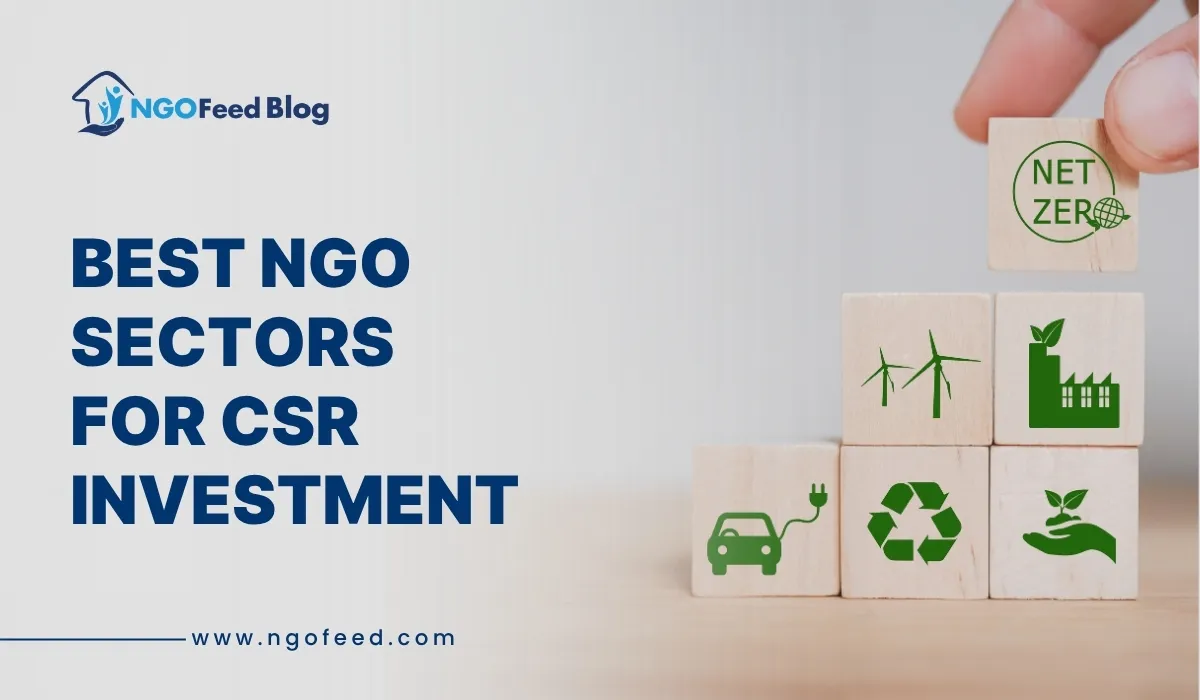
Corporate Social Responsibility (CSR) has become a major driver of sustainable development, enabling companies to contribute meaningfully to society while strengthening their social commitment. Through CSR initiatives, companies partner with NGOs to address pressing social, environmental, and economic challenges. However, selecting the right sector for CSR investment is as important as choosing the right NGO partner.
The best NGO sectors for CSR investment are those that create measurable impact, address urgent community needs, and align with long-term sustainability goals. Strategic investments in the right sectors can improve lives, strengthen communities, and contribute to national and global development priorities.
Table of Contents
Why Sector Selection Matters in CSR
Choosing the right NGO sector helps companies:
- Maximize social impact
- Address critical development gaps
- Align CSR with business values
- Improve stakeholder trust
- Build long-term sustainability
- Support national development goals
A well-planned sector focus ensures CSR resources are used effectively and responsibly.
Also Read: Corporate Social Impact
Best NGO Sectors for CSR Investment
1. Education
Education remains one of the most impactful sectors for CSR investment. Supporting education creates long-term social transformation by improving literacy, employability, and economic opportunities.
NGOs in this sector work on:
- School infrastructure
- Scholarships
- Digital learning
- Teacher training
- Skill development
- Child literacy programs
CSR investment in education helps reduce inequality and empower future generations.
Key impact areas:
- Improved school enrollment
- Better learning outcomes
- Reduced dropout rates
2. Healthcare
Healthcare is a critical CSR sector, especially in underserved communities where access to medical services remains limited.
NGO initiatives include:
- Free health camps
- Maternal healthcare
- Child nutrition
- Preventive care
- Disease awareness programs
- Rural healthcare services
Companies investing in healthcare help improve community well-being and reduce health disparities.
Common focus areas:
- Primary healthcare
- Mental health awareness
- Vaccination drives
- Health screening programs
3. No Keyword Research
Many NGOs produce material without knowing what people truly search for online.
For instance, an NGO could pen:
“Community-led educational reform projects”
But users might search:
- organization for underprivileged kids
- Support learning through contributions.
- Project supporting children
Rankings suffer if the website language does not correspond user search behavior.
Keyword research enables NGOs to find:
- Common search queries
- User objective
- Search frequency
- Level of rivalry
Using the appropriate keywords helps visibility greatly.
4. Slow Website Speed
Website speed impacts search results as well as user experience. A website load time that is too lengthy causes guests to depart fast.
Regular causes of slow NGO websites:
- Big image files
- Un satisfactory hosting options
- too numerous plugins
- Unoptimized programming
Google gives quick-loading websites preference since they improve the user experience.
A website that loads slowly leads to:
- Greater bounce rate
- Less involvement
- Lower search rank
Even a few seconds of delay might lose possible contributors.
5. Insufficient Mobile Experience
A lot of online users find websites via smartphones. Mobile consumers drive most of the internet traffic in nations like India.
Many NGO websites are not mobile friendly. Difficulties abound, among them:
- Font too little to read
- Buttons hard to press
- Bad navigation
- Broken designs
Google’s mobile-first indexing basically assesses the mobile of a website.
If a non-mobile experience is subpar, ratings could suffer.
6. Absent Local SEO Plan
Many charities provide certain communities or cities but neglect to maximize local search possibilities.
For instance, a Pune-based organization ought to aim at keywords like:
- Pune-based non-governmental organisation
- Pune-based charity groups
- Volunteer possibilities Pune
Nearby followers could never find the company without local SEO.
Local SEO covers:
- Google Profile for Businesses
- Keywords relevant locally
- pages based on locations
- Reviews and ratings
Particularly for grassroots groups, this is quite important.
7. Negative Backlink Profile
Links from other websites pointing to an NGO’s website are known as backlinks. Google sees backlinks as a trust indicator.
Many non-governmental organizations only have a limited number of excellent backlinks.
Factor Includes:
- minimal media attention
- No collaborations with online platforms
- No guest pieces
- Substandard digital PR
Excellent backlinks from:
- News websites
- University
- Other companies that are related
- official websites of the government
- can greatly raise rankings.
8. Not paying attention to technical SEO
Technical difficulties sometimes stop Google from indexing sites accurately.
Typical technical difficulties:
- Damaged pages—404 mistakes
- Missing sitemap
- Inefficient URL architecture
- Crawl mistakes
- Without HTTPS security
These problems impair visibility even when the material is excellent.
Technical SEO makes sure search engines could correctly read and access website pages.
9. Humanitarian Assistance and Disaster Relief
Natural disasters and crises call for fast response.
Nonprofits in this field offer:
- Emergency help
- Shelter aid
- Food distribution
- Medical treatment
- Rehabilitation aid
Companies funding catastrophe response enable areas to recover more rapidly amid emergencies.
10. Food Security and Nutrition
Food insecurity is still a big problem in many places that are already at risk.
NGO projects comprise:
- Meal schedules
- Knowledge of nutrition
- Programs for feeding children
- local kitchens
Prevention of malnutrition This sector immediately increases productivity and health.
11. Inclusion of People with Disabilities
Inclusive growth calls for assistance for those with impairments.
Nonprofit organizations in this field help with:
- Accessible learning
- devices for assistance
- skill development
- Inclusion in employment
- Rehabilitation
Investment in corporate social responsibility here helps to guarantee dignity and equality for everybody.
12. Digital Integration
More and more important for employment, education, and social involvement is digital access.
Nonprofit organizations help by means of:
- Digital knowledge
- access through the internet
- Device Disperson
- Tech instruction
- Digital empowerment
Digital inclusion helps underprivileged areas close the digital gap.
Also Read: CSR Growth in India
Emerging Industries for CSR Investment
Beyond established industries, businesses are progressively turning their attention to new fields like:
- Addressing the climate problem
- Knowledge of renewable energy
- Elderly assistance
- Mental well-being
- Teaching about cyber security
- Sustainable farming
- Social business
These industries show changing world priorities.
How Businesses Select the Top CSR Field
Most companies assess:
- Community requirements
- Business correspondence
- Possible social consequences
- Expertise of non-governmental organisation
- Availability of funds
- Outcome sustainability
Choosing sectors strategically raises CSR effectiveness.
Also Read: CSR & Sustainability
Elements contributing to a sector’s suitability for CSR investment
A perfect CSR sector should provide:
- Strong social importance
- Quantifiable results
- Scalability
- Sustainability
- Robust local participation
Segments fulfilling these standards typically draw more corporate investment.
Conclusion
The top NGO areas for CSR investment are those that solve major social and environmental issues and provide quantifiable, long-lasting influence. Still among the most important fields are education, healthcare, women empowerment, child welfare, environmental protection, and skill development.
CSR programs become strong instruments for inclusive growth, social transformation, and long-term sustainable development when businesses make strategic investments in the appropriate industries and work with skilled NGOs.
Also Read: CSR Development
Related NGO's Article Posts