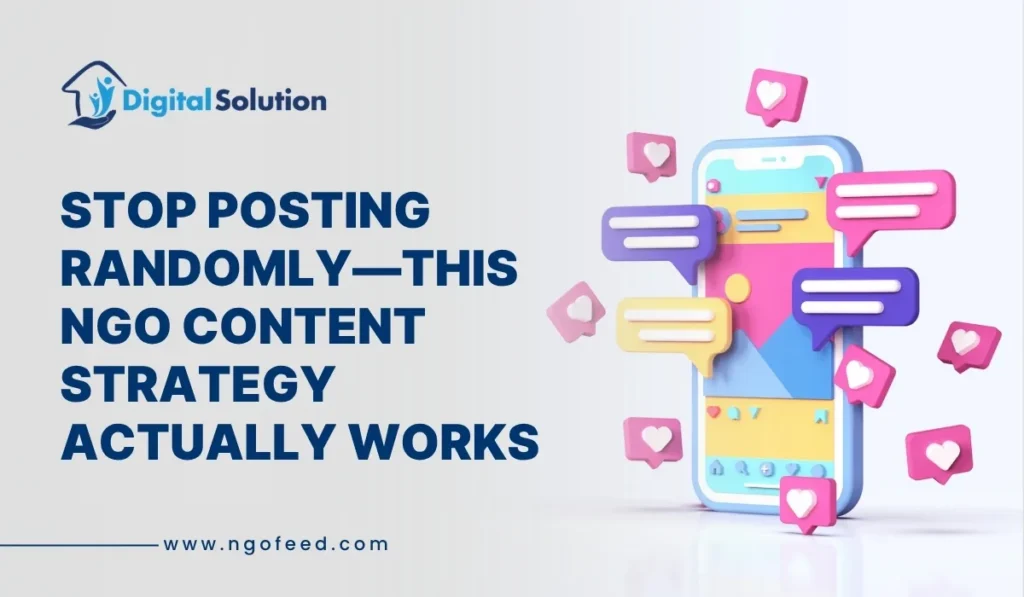
Many NGOs have a consistent presence on social media yet are still not getting the traction they need in terms of social media engagement, donations, volunteers or awareness. Why? Having a consistent posting schedule is not a content strategy.
Many nonprofit organizations become engulfed in “random posting” throughout the nonprofit field. It’s one day an appeal for donations, the next day a greeting to the festival, then a volunteer photo dump, then a motivational or inspirational quote that has nothing to do with the festival. This leads to mixed messaging, confusion amongst the audience, and a lack of engagement.
Content marketers are making it a point to understand that unstructured content doesn’t last long. Content pillars and aligning with audiences, keeping content consistent and setting measurable objectives are the foundations of modern content strategy frameworks rather than posting more frequently.
Other nonprofit research also reveals that the most effective NGOs use social media in three key ways:
- Information
- Community building
- Action-taking
Rather than visibility, which may be random.
As noted in the competitor analysis, there is a common thread throughout all these successful nonprofit marketing strategies as to what the NGOs are doing to grow online; they’re doing it for a reason. Content pillars, story, platform-focused strategies and audience trust are much more important than posting daily.
This article explains a real-life, actionable NGO content strategy that will help you stop posting just any content and start posting content that gets results – results like engagement, trust, and results that matter to your organization.
Table of Contents
Why Random Posting Hurts NGO Growth
One of the biggest mistakes that NGOs make when posting on social media is not being directed.
There are several issues to consider for random posting:
- Inconsistent messaging
- Audience confusion
- Low engagement
- Weak brand identity
- Creative burnout
For instance, if an NGO shares educational posts on one day, entirely different memes the next, and then sudden requests for donations afterwards, followers have a hard time figuring out what this organization is about.
Content marketing research also indicates that consistency is one of the most crucial elements to developing trust and recognition with your audience. A lack of organization’s message is often the reason they don’t create a strong community online.
The other problem that arises with random posting is that it is more about the activities of the organization than its value for the audience. Many NGOs post updates just because they feel they “should post something,” but not because they have a strategic value.
At the very least, successful NGO content should provide answers to one question:
Does this educate?
Does this inspire?
Does this inspire trust?
Does this motivate action?
Content without a purpose is noise.
Also Read: Grow Your NGO with Content Marketing
Define Clear Goals Before Creating Content
The first step in creating content is for NGOs to have a clear objective in mind.
The strategies used to achieve different goals are different.
Your NGO’s objectives can be:
- Increasing donations
- Recruiting volunteers
- Raising awareness
- Social media popularity is rising.
- Building donor trust
- Increasing website traffic
Without clear goals, content will be disjointed and ineffective.
For example:
- Content for donor trust is about transparency and impact stories.
- For awareness, develop education materials and social campaigns.
- Community involvement and team culture are good points to emphasize when recruiting volunteers.
The best content strategy starts with goals and audience alignment, marketing experts say.
Example of a Weak Goal
Post on Instagram more.
Example of a Strong Goal.
Boost volunteer enrollment by 25% in 3 months via learning reels and storytelling messages.
Clear goals help to make content more focused and measurable.
Also Read: Content That Drives NGO Impact
Build Strong NGO Content Pillars
The best solution to end the random posts is to have content pillars.
Content pillars are the primary topics that your NGO shares on social media. Pillars aren’t about building content from scratch each day but rather offer structure and clarity.
Ideally, there should be 3-5 strong content pillars for greater consistency.
Make sure the NGO’s content pillars are effective.
Educational Content
Educate people on social issues, myths, facts, awareness topics.
Impact Stories
Share true stories of beneficiaries, transformations and project outcomes to the extent possible.
Behind-the-Scenes Content
Demonstrate volunteerism, field work, office life, and the routines of the day.
Community Engagement
Create polls, Q&As, campaigns and interactive content to connect with people.
Fundraising & Campaign Content
Donation drives, campaigns, CSR Partnerships and event promotions.
Content pillars benefit NGOs by:
- Stay organized
- Reduce content stress
- Build authority
- Create audience familiarity
If the audience is exposed to the same theme(s) repeatedly, trust and recognition will naturally develop.
Also Read: Winning Content Strategies for NGOs
Use Storytelling Instead of Constant Promotion
Don’t make the mistake that many NGOs make of asking for donations constantly without creating an emotional connection first.
Statistics are not enough, people need stories to relate to.
Good stories enable listeners to:
- Understand the mission
- Feel emotionally involved
- Remember the organization
- Rely on the effect that is being produced
Nonprofit communication research has demonstrated that storytelling leads to better audience connection than mere information broadcasting.
Weak NGO Post
This month, 1000 meals were distributed.
Strong NGO Story
Rani lost her husband last year and had trouble providing food for her children, but today, with community support, her family can feed her children regularly, and her children can attend school.
Stories humanize impact.
Good NGO Storytelling includes:
- Real people and experiences
- Emotional journeys
- Challenges and solutions
- Authenticity
- Hope and transformation
But the moral and respect of storytelling should always be respected. NGOs should be careful of the imagery and the content they portray, which may be exploitative and dehumanizing for the beneficiaries.
It’s not sympathy marketing; it’s the goal of connection.
Also Read: Boost Your NGO with Better Content
Create a Sustainable Content Calendar
The lack of planning is one significant challenge for NGOs to achieve consistency of content.
If there is no system, content will be stressful and will be a reactive process.
A content calendar can assist NGOs in:
- Schedule campaigns ahead of time
- Maintain consistency
- Reduce last-minute posting
- Balance content types
- Avoid burnout
Experts are increasingly suggesting the use of sustainable workflows rather than pressure posting on a daily basis.
Example Weekly NGO Content Plan
| Day | Content Type |
|---|---|
| Monday | Educational carousel |
| Tuesday | Volunteer spotlight |
| Wednesday | Awareness reel |
| Thursday | Behind-the-scenes post |
| Friday | Beneficiary story |
| Saturday | Community engagement |
| Sunday | Fundraising CTA |
It is consistency, not perfection, that is the key.
NGOS don’t need to post several times a day in order to be successful. It’s better to post 3-4 quality, meaningful posts a week than having a ton of random posts per day.
Pre-made content is also high-quality and time saving.
Also Read: Content Marketing That Works for NGOs
Track Results and Improve Your Strategy
There’s no guesswork in a successful NGO content strategy.
Focus on vanity metrics are not present in many organizations:
- Likes
- Followers
- Views
Visibility is important, but true success is through impactful results.
Some of the key metrics of NGO content are:
- Donations generated
- Volunteer sign-ups
- Website clicks
- Email subscribers
- Engagement rate
- Shares and saves
- Community participation
But studies indicate that firms become more active and effective when they routinely measure and fine-tune the effectiveness of their content.
Ask Questions Like:
- What content type resonates the most with the audience?
- So, which posts get the most donations?
- Which platform is best?
- Which stories do the emotions link to?
Data can reveal what really connects with audiences for the NGOs.
The ideal strategies will develop over time based on testing, learning and improving.
Also Read: How NGOs Create Engaging Content
Conclusion
One of the most common reasons NGO pages don’t grow on the Internet is that they’re posted randomly.
It is not the number of posts that make an organization successful, but purposeful posting. They create systems on the basis of:
- Clear goals
- Strong content pillars
- Audience understanding
- Emotional storytelling
- Consistent planning
- Strategic measurement
With all the noise in the digital world, NGOs that communicate strategically will be seen much more than those who just post random posts.
Also Read: NGO Content Tips That Deliver Results
Related NGO's Article Posts