Guardians of Our Streets: The Spiritual Journey of Dashrath Putra Foundation: Dashrath Putra Foundation, a flagship initiative of Radhey Sewa – The Street Defenders. In the rapidly expanding urban landscapes of Bharat, from the gleaming high-rises of the Millennium City, Gurugram, HR, Bharat to the bustling streets of our metropolitan hubs, a silent conflict often unfolds. It is the conflict between modern convenience and ancient compassion, specifically regarding our street dogs. Often viewed as a nuisance by those who equate a “world-class city” with sterile, lifeless streets, these voiceless souls are frequently subjected to cruelty, displacement, and neglect.
However, to view them merely as a civic issue is to suffer from a profound spiritual amnesia. In Sanatan Dharma, the presence of a dog is not a problem to be eradicated, but a profound spiritual test and a direct link to the divine. Throwing them out does not make a society well-maintained; protecting and nourishing them does. To truly understand the gravity of animal welfare, it becomes necessary to look beyond modern activism and return to traditional perspectives, specifically to the fierce and protective grace of Lord Kaal Bhairav.
Table of Contents
The Divine Vahana: Lord Kaal Bhairav and the Shvan
Lord Kaal Bhairav is revered as the fierce, terrifying, yet infinitely compassionate manifestation of Lord Shiva. He is the Lord of Time, the ultimate destroyer of ego, and the supreme guardian of the universe. Famously known as the ‘Kotwal of Kashi’ (the divine police chief of Varanasi), no one can enter, reside in, or leave the sacred city without his permission.
But what is most striking about this supreme protector is his chosen companion and vehicle (Vahana) - the Shvan, or the native dog. Why did the Lord of the Universe choose a dog? In ancient times, and even today in unaware societies, dogs were often considered scavengers, outcasts or impure.
By elevating the dog to the status of his divine vehicle, Lord Shiva delivered a powerful message that echoes through eternity: “In the inauspicious lies the auspicious.” The Divine does not reside only in pristine temples or sanitized palaces; He is fiercely present in the discarded, the wandering, and the marginalized.
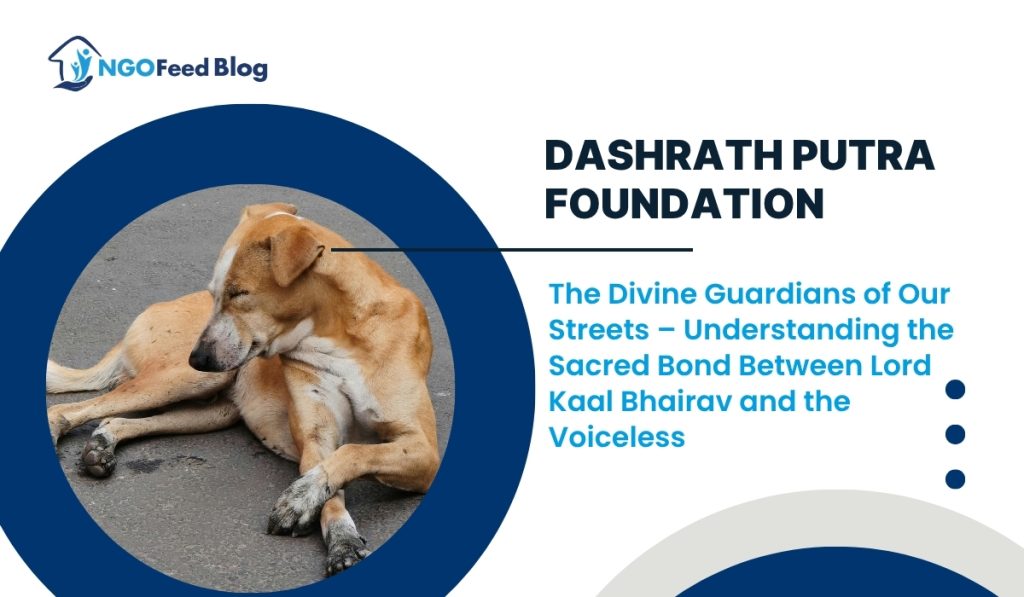
The dog represents inner alertness, unwavering loyalty, and the ability to perceive what ordinary eyes ignore. When we look into the eyes of a street dog, we are not just looking at a hungry animal; within this belief system, it is also viewed as the sacred guardian of the Kashi Kotwal. To mistreat them is associated with inviting the wrath of Bhairava, while feeding them is believed to bring His grace.
The Vedas in Canine Form: The Deeper Sanatan Symbolism
The reverence for dogs in Sanatan Dharma extends far beyond Kaal Bhairav. If we look at the sacred iconography of Lord Dattatreya - the supreme ascetic who embodies the combined energies of Brahma, Vishnu, and Shiva - he is always depicted accompanied by four dogs. These are no ordinary animals; scriptures explicitly state that these four dogs represent the four holy Vedas: Rig, Yajur, Sama, and Atharva.
The Vedas are not just static books of knowledge; they are living, breathing truths that require vigilance, humility, and loyalty - qualities perfectly embodied by the dog. The dog walks with the Divine because true knowledge must be alert, not asleep in mere ritual. By portraying the highest spiritual knowledge as dogs, Sanatan Dharma presents the idea that wisdom is associated with humility and unconditional presence.
Furthermore, the great epic Mahabharata culminates with a profound lesson involving a dog. When the righteous King Yudhishthira undertakes his final journey to the heavens, he is accompanied by a stray dog. When Lord Indra arrives in his celestial chariot and asks Yudhishthira to leave the dog behind, citing that dogs have no place in heaven, the King refuses. He states that abandoning a loyal companion who sought his refuge is an unpardonable act, a violation of his core Dharma.
Pleased by this ultimate test of righteousness, the dog transforms into Lord Yama, the God of Dharma himself. This narrative is often interpreted as demonstrating that the treatment of a stray dog reflects an individual’s adherence to righteousness.
The Spiritual Science and Karmic Significance of Feeding Dogs
Beyond mythology, the act of feeding and protecting street dogs carries immense astrological and karmic weight in Vedic sciences. Astrologically, the dog is closely associated with the shadow planets (Rahu and Ketu) and Lord Shani (Saturn). Individuals experiencing the malefic effects of these planetary alignments - such as sudden downfalls, deep anxieties, financial blockages, or karmic debts - are often advised by traditional practitioners to serve street dogs.
Feeding a dog is not merely an act of charity; it is also interpreted as a form of karmic balancing. It is believed to pacify certain planetary influences. When a hungry dog eats the food provided, the satisfaction associated with the act is considered spiritually significant. It is also believed that regular feeding of dogs pleases the ancestors (Pitrus) and contributes to peace within one’s lineage.
During spiritually significant periods, offering food to dogs is considered a symbolic offering to Lord Kaal Bhairav, with the belief that it provides protection from negative influences and unforeseen difficulties.
Protection, Not Eviction: The Path to True Development
Today, as cities continue to develop and digital infrastructures expand, questions arise about the ethical and social foundations of urban life. A well-maintained society is not necessarily one that removes the vulnerable to create an appearance of cleanliness. A more inclusive perspective defines development as the ability to extend compassion to all living beings.
The removal, displacement, or harm of street animals does not resolve underlying issues and may instead contribute to ethical and ecological imbalances.
As the following traditional belief states:
“काशी के कोतवाल की सीधी कृपा - इन बेजुबानों का पेट भरना, साक्षात काल भैरव की शरण में जाना है और यही उनकी हर पल रक्षा करना है।”
(The direct grace of the Kotwal of Kashi - feeding these voiceless souls is akin to taking refuge in Kaal Bhairav himself and this is what it means to protect them at every moment.)
Activities such as creating feeding spaces, providing medical care to injured animals, and allowing them to exist peacefully within communities are often viewed as forms of social responsibility as well as spiritual engagement.
Reawakening the Soul of Bharat
The transformation of the nation into a Vishwa Guru is often associated not only with economic, structural, or technological progress, but also with a broader cultural and spiritual awareness. Bharat has historically been described as a land of coexistence, where rivers are revered, trees hold cultural significance, and animals are considered companions within a shared ecosystem.
This perspective emphasizes the importance of preserving such values within modern society. The presence of street dogs, often seen at street corners or within neighborhoods, is interpreted within this framework as part of a larger spiritual and cultural narrative connected to Lord Kaal Bhairav.
Related NGO's News Posts