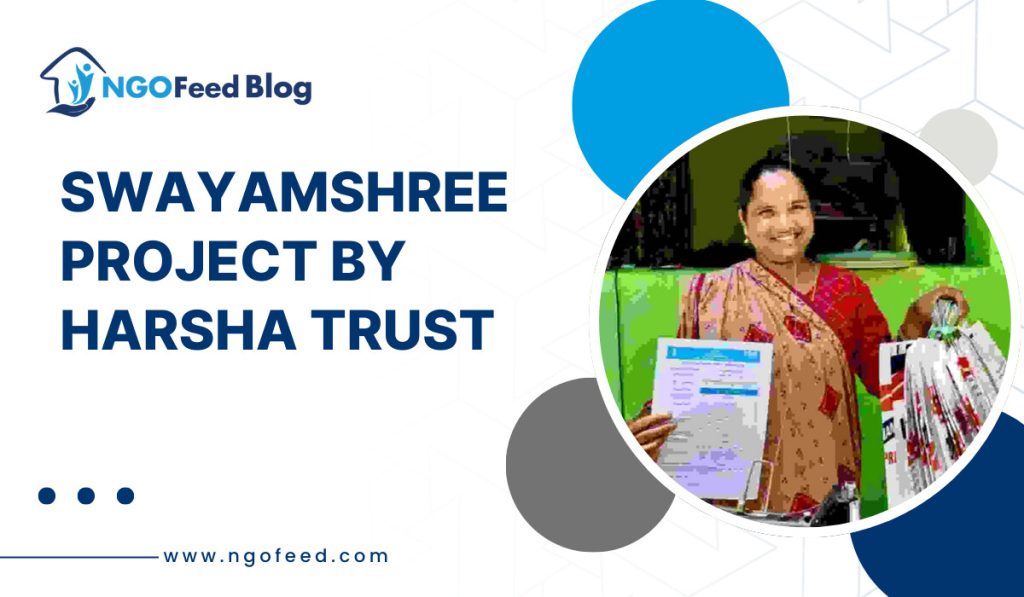
Harsha Trust SWAYAMSHREE Project: In Santoshpur village, a quiet but powerful shift is unfolding as women embrace non-farm entrepreneurship through project SWAYAMSHREE- an intervention from Harsha Trust and Reliance Foundation and Bill & Melinda Gates Foundation. Women have been involved in bag stitching activity which is transforming their livelihood pattern ensuring income stability and financial independence. What began as a new skill introduced through training and support has now evolved into a viable income-generating enterprise, giving women a pathway beyond traditional agriculture and daily wage labor.
This newfound livelihood has not only improved their household income but has also provided them with digital literacy skills and a stable source of earning for their families. Today, these women stand proudly as entrepreneurs, managing their work, negotiating prices and maintaining quality. Their journey reflects more than economic progress, it is a story of empowerment, dignity and the collective belief that skills and opportunity can rewrite the future.
Table of Contents
Harsha Trust SWAYAMSHREE Project – Story of Jharina Gonda
In the quiet lanes of Santoshpur village, the rhythmic hum of a sewing machine has become a symbol of resilience and reinvention. For Jharina Gonda, a women entrepreneur, this sound represents not just work, it reflects dignity, independence and a future she once believed was beyond her reach.
For nearly five years, Jharina ran a small tailoring business from her home. With the purchase of her own sewing machine, she stitched blouses, night gowns, dresses and other household garments for women in the community. In the early years, work was steady and her income predictable. She felt content, believing this would remain a stable livelihood path. However, over time, as more women in the village and surrounding areas adopted tailoring as a source of income, competition increased. Orders slowed and the once-reliable earnings dwindled. Despite her skills and experience, sustaining her business became increasingly difficult.
Meanwhile, agriculture, the family’s secondary income source, offered little relief. Her husband and his four brothers jointly owned just one acre of land, cultivated in a fragmented manner and dependent entirely on seasonal paddy. With unpredictable yields and fluctuating market prices, farming could not meet household needs. The family found themselves navigating economic uncertainty, and the pressure on Jharina to contribute more significantly to household income grew.
The Turning Point: Skill Alignment and Market Linkage
The turning point in her journey came with support from Harsha Trust, which recognized her existing tailoring skills and encouraged her to expand into a specialized skill, bag stitching, under a structured livelihood model. As part of the intervention, she received orientation and exposure to new stitching techniques tailored to bulk bag production.
More importantly, she was linked to a buyer who supplied raw materials directly to her doorstep and collected finished products at predefined intervals, a secure buy-back arrangement that eliminated market risks and ensured steady income.
Income Stability and Financial Growth
Today, Jharina stitches two types of bags: small bags for which she receives ₹1.25 per piece, and larger ones for ₹3 per piece. Depending on household responsibilities and social commitments, she stitches 12 to 15 dozen bags per day, earning approximately ₹500 to ₹600 daily.
Working flexibly for 22 to 25 days each month, she now earns a consistent ₹12,000 to ₹15,000 monthly, a level of financial stability she had never experienced before.
From Economic Security to Community Leadership
With a stable and predictable income, Jharina’s life has taken a remarkable turn. Today, she is able to provide her family with nutritious food, ensure consistent schooling for her two children and plan for future improvements, something that once felt out of reach. She now dreams of renovating her home, with a pucca roof that symbolizes security and progress.
Beyond improving her own life, Jharina has naturally emerged as a role model in her community. Women who once doubted their abilities now look to her for guidance and inspiration. She willingly trains and mentors them, patiently teaching stitching techniques, sharing lessons from her journey and building their confidence step by step. Her leadership has sparked a ripple effect, motivating more women to pursue income opportunities and believe in their potential.
Confidence, Dignity and Decision-Making Power
Beyond income, the transformation has brought profound emotional and social change. Jharina now speaks with confidence about her work, manages her production schedule independently and contributes significantly to household decisions. The fear and financial vulnerability that once shadowed the family have been replaced with optimism and planning for the future.
Jharina’s story is more than a livelihood case, it is a testament to how targeted support, skill alignment and market linkage can unlock potential and restore dignity. Through determination, opportunity and the courage to adapt, she has stitched not only bags but a stronger, secure and self-reliant future for her family.
Jharina Gonda’s Words
“A few years ago, I felt like everything I had built was slipping away. Tailoring was something I loved and depended on but when more women around me began doing the same work, the orders reduced and my income slowly disappeared. But things changed when Harsha Trust encouraged me to try stitching bags.
At first, I was unsure, new work, new expectations and fear of whether I could manage it. But the training and support gave me confidence. When I was connected to a buyer who supplied materials and promised to buy everything I stitched, something inside me shifted. For the first time in years, I felt secure.
I now earn ₹12,000–₹15,000 a month and I work with dignity, on my own terms. I no longer depend or wait for orders. I decide my pace, my work hours and my goals. My life is different now. I feel respected. I feel confident. And I feel proud that I stood back up when life pushed me down.
This opportunity didn’t just give me income; it gave me my identity back. Today, I believe that women like me are not weak. We only need one chance. One door. One skill.”
— Jharina Gonda
Access to Entitlements and Digital Empowerment (Jharina Gonda)
Access to Entitlements: Jharina has been supported with facilitation for UDAYAM registration. With facilitation from Harsha Trust, she has been able to apply to DIC for a big size stitching machine which can significantly improve her outputs. For this, she will get a subsidy of 30% and the remaining 70% will be her contribution through Bank loan. Along with this, she has also opened an RD account in the local Post office for Rs. 500 per month.
As part of the intervention, Harsha Trust also facilitated digital literacy and online payments training, enabling women like Jharina to confidently use smartphones for financial transactions. Through hands-on sessions, she learned how to operate essential digital applications, make and receive online payments, check account balances and maintain digital records. This training has not only reduced her dependence on cash but also increased transparency and financial security in her business dealings. Today, Jharina comfortably manages payments with vendors and conducts transactions independently, reflecting a significant step toward digital empowerment and economic self-reliance.
Village-Level Impact: A Ripple Effect
Inspired by Jharina’s success and confidence, nearly 30 households in the village have now adopted bag stitching as a livelihood, marking a significant transition toward non-farm income opportunities. Seeing her steady earnings, growing independence, and improved quality of life encouraged other women to step forward and learn the skill.
Many of them received training, market linkage, and digital financial literacy support through Harsha Trust, allowing them to follow the same structured model. Today, these households are earning a reliable and dignified income, reducing their dependence on seasonal agricultural work and uncertain wage labour. The ripple effect of Jharina’s journey has transformed the livelihood landscape of the village, demonstrating that when one woman rises, an entire community finds the courage to believe in a new possibility.
Story of Subhasita Nag
In Santoshpur village, where agriculture and wage labour are the most common sources of income, Subhasita and her husband, Bhaskar Nag, worked tirelessly to secure a basic living for their family. Their two-acre farmland was used solely for seasonal paddy cultivation, providing food security but very little income.
To supplement earnings, Bhaskar travelled within and beyond nearby villages of Jeypore and Boriguma, working as a mason whenever opportunities arose. Despite their best efforts, their income was just enough to manage household needs, leaving no room for savings. With two young daughters in school, the couple often worried about their future, education and financial stability.
Learning from a Peer and Taking the First Step
During this period of uncertainty, change came from an unexpected source, a fellow villager, Jharina, who had transformed her life through bag stitching entrepreneurship. Observing her progress, confidence and growing income, Subhasita felt hopeful and motivated for the first time. Encouraged by the possibility of earning from home, she expressed her interest in learning the skill.
Through the intervention facilitated by Harsha Trust, Subhasita received structured training directly from Jharina. The learning was practical and paced according to Subhasita’s need. However, the decision to begin was not simple, Bhaskar initially had reservations and doubted whether stitching bags could bring meaningful earnings. But with reassurance from the project team and seeing tangible examples of its impact, he supported her decision to pursue this opportunity.
A New Livelihood and Financial Independence
As part of the programme, Subhasita received a stitching machine, enabling her to begin production without financial burden. With consistent practice, she quickly became proficient in stitching high-quality bags that met buyer specifications. The model provided by Harsha Trust ensured a buy-back mechanism, eliminating the risks of marketing, middlemen dependency or price negotiation.
Today, Subhasita stitches two types of bags: small bags for which she receives ₹1 per piece, and larger ones for ₹2.50 per piece. Depending on household responsibilities and social commitments, she invests 5-6 hours daily for this work and stitches 300 to 400 bags per day, earning approximately ₹14,000 to ₹15,000 monthly.
Access to Entitlements and Digital Literacy (Subhasita Nag)
Access to Entitlements: Subhasita has also been supported with facilitation for UDAYAM registration. Along with this, she has also opened an RD account in the local Post office for Rs. 500 per month. She also invested in Sukanya Samriddhi Yojana for her 2 daughters.
Subhasita received training on digital literacy and online payments training, enabling her to confidently use smartphones for financial transactions. She can now make and receive online payments and check her account balance. This is a significant step toward digital empowerment and economic self-reliance.
Subhasita Nag’s Words
“There was a time when I believed that my life would always remain the same, seasonal farming, my husband going out for masonry work and just enough income to survive. I often worried about my daughters’ future because we could not save anything for their education or security.
When I saw how stitching changed Jharina’s life, something awakened in me, a small belief that maybe I, too, could do something. At first, I was scared. I had never earned before, and I wasn’t sure if I could learn or manage.
Today, I stitch bags with pride. I earn from my own hands and I no longer feel dependent. Both me and my husband have decided to invest the entire income from bag stitching for our daughters’ education and their future. My husband also sometimes supports me in my work and tells others with pride and that means everything to me.”
— Subhasita Nag
Related NGO's Success Stories Posts