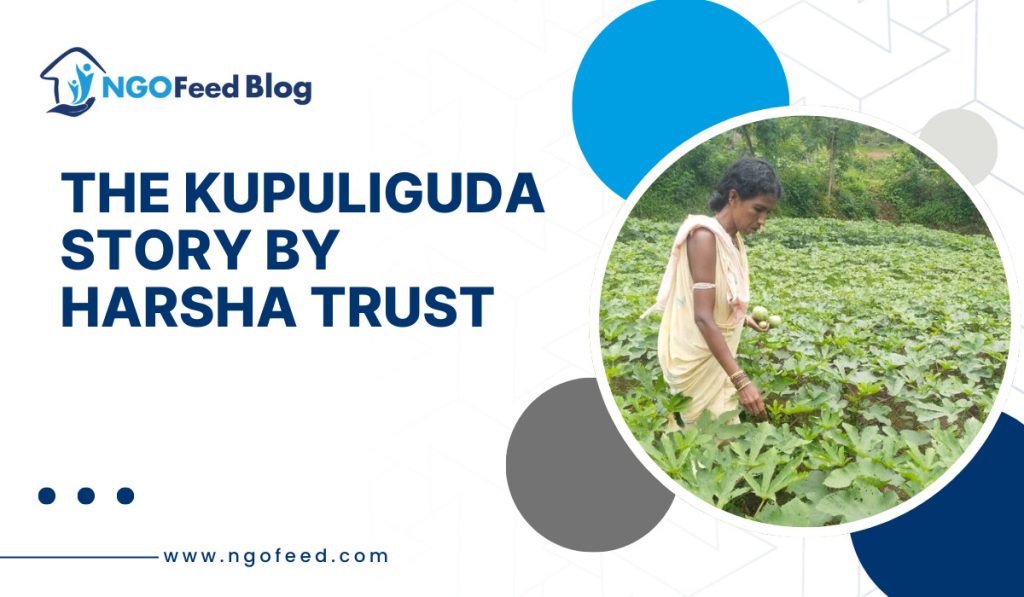
Harsha Trust Impact Story: Kupuliguda is a small hamlet in Boipariguda block of Koraput district, home to 22 Bhumia tribal households who have long depended on subsistence farming, livestock rearing, and seasonal migration for survival. Limited education, water scarcity, poor sanitation and minimal market access kept incomes low, often below ₹30,000 annually per household and restricted women largely to household roles. Farming was practiced mainly for consumption, with little surplus or savings.
Table of Contents
The Turning Point: Institutional Strengthening and Livelihood Support
This trajectory began to change in 2023 with Harsha Trust’s intervention, supported by Axis Bank Foundation, focusing on livelihood diversification, institutional strengthening, and access to entitlements. The programme strengthened two women’s Self-Help Groups, Maa Saraswati SHG and Srimaa SHG, reviving regular savings, improving bank linkages and enabling access to credit.
Five SHGs came together to form a Cluster Level Forum (CLF), with sub-committees on livelihoods, social issues and financial inclusion, creating a platform for collective planning and leadership.
Livelihood Diversification and Economic Resilience
As institutions grew stronger, livelihoods diversified. Women adopted improved agricultural practices such as line transplanting for millets and paddy, vegetable cultivation, nutrition gardens, mushroom farming and marigold and sunflower cultivation.
Livestock rearing shifted from subsistence to an income-generating activity through scientific practices, vaccination support and improved sheds. By 2025, most households had multiple income streams, access to irrigation, job cards, ration cards, insurance and bank accounts, many in women’s names.
Transformative Outcomes and Income Growth
The results have been transformative. Average annual household incomes rose to over ₹1 lakh by 2025. Women began selling millets directly at government mandis under the Odisha Millet Mission, earning ₹50,000–60,000 annually from millets alone.
SHGs evolved into enterprises, running tent house services, fish farming ponds, millet processing units and organic input production. Women like Rohilla Bhumia and Kamalaka Bhumia emerged as entrepreneurs and trainers, earning additional income while supporting neighbouring villages.
Social Empowerment and Local Governance
Economic empowerment translated into social and political voice. Women now regularly participate in Gram Sabha and Palli Sabha meetings, successfully advocating for roads, meeting spaces, access to welfare schemes, and even the closure of a disruptive liquor shop.
Collective action resulted in job cards for 14 households, PMAY housing for 10 families, and approval of a ₹21.4 lakh Integrated Natural Resource Management Plan.
Strengthening the Social Fabric
Beyond income, Kupuliguda’s social fabric has strengthened. Women contribute to community events, support each other during crises, save collectively and invest in assets such as livestock, housing improvements and small amounts of gold.
From subsistence farmers, they have become entrepreneurs, financial managers, trainers and community leaders.
A Model for Replication
Kupuliguda’s journey demonstrates how integrated livelihood support, strong women’s institutions and sustained handholding can drive climate-resilient growth, gender equity and local governance offering a replicable model for tribal and remote communities across Odisha.
Community Voice
“The women of Kupuliguda are proud to announce a significant milestone: the Integrated Natural Resource Management Plan (INRMP), amounting to Rs 21.4 Lakh, has been successfully submitted and half of it has been approved in the Gram Sabha for this year. This achievement is a testament to our community’s collaborative spirit and dedication to sustainable development”.
Conclusion
Women from the Bhumia tribe are quietly rewriting their future, transforming subsistence livelihoods into diversified, climate resilient enterprises through collective action, institutional strength and growing confidence.
Related NGO's Success Stories Posts